Revenge Quitting Creates New Challenges for Recruiters

October 30, 2026 – You spend weeks helping a team find the right person. A few months later, that same role lands back on your desk because the employee has resigned. Now the position is urgent, the hiring manager wants a replacement right away, and the pressure is coming from every direction. When exits like this occur at particularly painful moments, it’s called revenge quitting, according to a recent report from Recruit CRM, an AI-first ATS + CRM platform built for recruitment, staffing and executive search firms. The study lays outs exactly what this trend is and how you can prevent it.
“Revenge quitting is a situation in which an employee resigns at a moment that deliberately creates disruption and chaos in the workplace,” the report explained. “The intention is not simply to leave the job. The timing of the exit is meant to send a message to the organization.”

Revenge quitting rarely happens without warning. Frustration typically builds over time as smaller issues accumulate and go unresolved. Eventually, one incident pushes the employee to leave, often choosing a moment when their departure will have the greatest impact.
Top 5 Reasons Behind Revenge Quitting
1. Mismatch Between Promises and Reality.
One of the biggest triggers behind revenge quitting is the gap between what candidates are promised during recruitment and what the job actually looks like after they join according to the Recruit CRM study. “When recruiters do not probe the client deeply enough about what the role looks like day to day, or when they oversell an opportunity to close a placement faster, candidates join with expectations that the employer was never going to meet,” it said. “During the hiring process, candidates may hear about growth opportunities, flexible work arrangements, strong leadership, or meaningful projects.”
“But after joining, strategic work turns into routine tasks, decision-making is limited, or flexibility quietly disappears,” the report continued. “Most employees give the role time and raise concerns with their manager or during performance reviews. When those concerns are repeatedly dismissed, disappointment gradually turns into frustration.”
2. Lack of Recognition and Feedback.
Employees want to know their work matters and when someone consistently delivers results but rarely receives feedback or recognition, motivation begins to drop. “Over time, employees may feel their contributions are invisible,” the Recruit CRM report said. “Instead of repeatedly raising the issue, many simply withdraw. They stop sharing ideas, stop volunteering for extra work, and slowly disengage from the team. This is a warning sign that often goes unnoticed by agency recruiters because most agencies lack a structured process to check in on placed candidates after the start date.”
3. Perceived Unfair Treatment.
Fairness strongly affects employee engagement and retention, the Recruit CRM report pointed out. Employees notice when workloads are uneven, when certain colleagues receive better opportunities, or when workplace policies apply differently across teams. Even small patterns of favoritism can create resentment if they continue long enough.
 Inside the Decisions That Shape Hiring and Careers
As hiring becomes more complex, employers are placing greater emphasis on judgment, adaptability, leadership potential, and the ability to deliver results in changing environments. HIRECLOUT founder and CEO Avetis Antaplyan recently sat down with Hunt Scanlon Media to discuss HIRE Calling, how companies identify high performers, and the growing role of AI in recruiting. He also shared his views on career advancement, promotions, and what it takes to build stronger teams.
“You can surface this risk before placement by asking candidates about their past experiences with team dynamics and management styles, and cross-referencing those answers with the client’s description of their culture,” the Recruit CRM report said. “When employees start believing the system is unfair, trust in leadership begins to decline.”
4. No Clear Path for Career Growth.
Career development is a major reason employees stay with a company, the Recruit CRM report also added. “Many join expecting their role to evolve, with opportunities to build new skills or take on greater responsibility,” it said. “Problems arise when those conversations never translate into real opportunities. Promotions are delayed, internal roles never open up, and career discussions repeat without progress. Eventually, employees begin to believe the only way to grow is to leave.”
Related: Leadership in Uncertain Times: How Executives Adapt
To avoid this, Recruit CRM says that you need to ask clients directly what progression looks like for the role and communicate that honestly to candidates, not just at the offer stage but throughout the process. If the client can’t answer it clearly, it is a risk worth mentioning to the candidate.
5. Frustrations That Build Over Time.
In revenge quitting instances, there is no single dramatic incident behind the resignation. “Instead, small frustrations accumulate,” the Recruit CRM said. “Missed promotions, unclear communication, workload pressure, or repeated misunderstandings with leadership. Each issue may seem manageable on its own, but together they create a growing sense that nothing will improve. By the time the employee resigns, the decision often feels sudden to the organization but long overdue to the employee.”
“Because agencies typically hand off after a placement is made, this slow buildup becomes invisible to them,” the report continued. “By the time the candidate resigns, the decision often feels sudden to the client but long overdue to the candidate. Regular check-ins at the 30-, 60-, and 90-day marks with both the placed candidate and the hiring manager would catch many of these frustrations before they reach a breaking point.”
What Can Recruiters Do To Prevent Revenge Quitting?
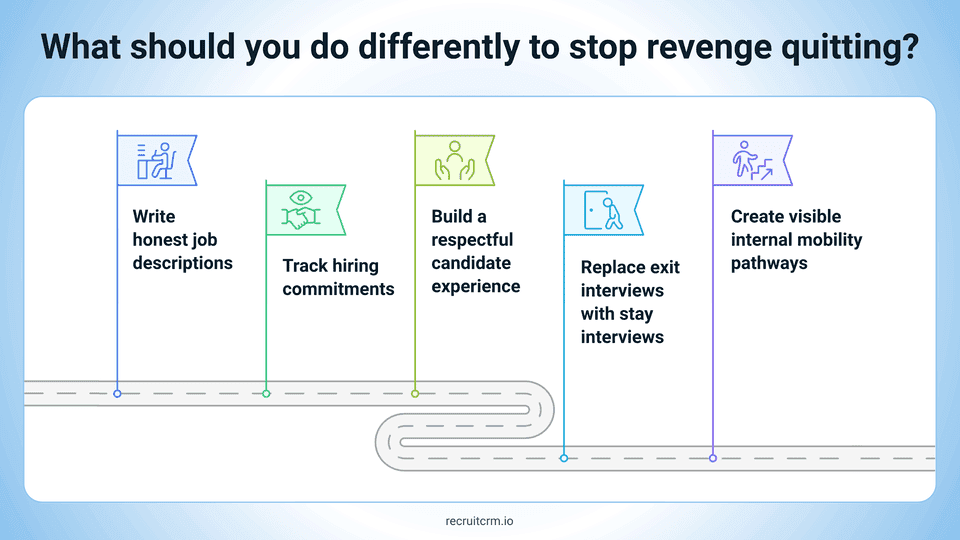
1. Qualify the Client Brief Rigorously.
Job descriptions are the first place candidates form their expectations, and they need to reflect the reality of the role, the Recruit CRM report points out. “Too often, agencies write descriptions based on a surface-level brief without pushing the client on what the role actually involves day to day,” the study said. “If the role promised growth, autonomy, and exciting projects but turns out to be more operational or repetitive, the employee may quickly feel misled and quit in revenge.”
Related: Executive Search as Strategic Risk Management: Five Insights Reshaping C-Suite Hiring
“To avoid this, be upfront about the role’s responsibilities and the challenges employees will face,” Recruit CRM said. “Describe the team dynamics, leadership style, and growth timelines clearly. Include both the good and the challenging parts of the job. Regularly audit your recruitment messaging, including job ads, career pages, and employer value proposition, to compare what’s promised during hiring to the actual employee experience. If you find gaps between the two, address them immediately.”
2. Track Hiring Commitments.
Promises made during interviews can be overlooked once the employee joins, leading to dissatisfaction and disengagement, according to the Recruit CRM report. “Employees may have been told about growth opportunities or special projects, but when those promises aren’t fulfilled, trust is lost,” the study said. “For this reason, you should document the key promises made during the hiring process regarding mentorship, career development, or team structure. Share this information with the hiring manager during onboarding to ensure alignment on both sides. This also protects the agency. When a placement exits early, and the client pushes back, having a record of what was communicated and to whom gives you a clearer picture of where the breakdown happened.”
3. Build a Respectful Candidate Experience.
From the moment candidates apply, they are forming an opinion about the agency and, by extension, the client, the Recruit CRM noted. “How they are treated during recruitment directly shapes how they feel about the role before they even start,” the study explained. “A slow process, unclear timelines, or lack of communication can create a negative candidate experience, even if the role itself is a good fit. Ensure timely communication with candidates throughout the process. Set clear expectations about timelines, respond quickly to questions, and provide feedback after interviews. The way you run the hiring process sends a signal about the kind of employer the client is.”
4. Replace Exit Interviews With Stay Interviews.
Exit interviews are helpful, but by the time you conduct them, the employee has already decided to leave. Stay interviews, on the other hand, help you identify concerns before the resignation is even on the table. Schedule regular stay interviews to check in with employees about their job satisfaction. Recruit CRM says to ask questions like:
- “What’s frustrating you about your role?”
- “Do you feel you’re getting the growth opportunities you were promised?”
- “What part of your job is the most frustrating right now?”
- “Are there any changes you’d like to see in the team or role?”
“Use this feedback to address issues early, before they turn into long-term frustrations that could lead to revenge quitting,” the report added. “Stay interviews also signal to employees that their well-being matters and that the company is committed to making improvements.”
5. Flag and Manage High-Risk Placements.
Not every role carries the same attrition risk, and agencies that treat all placements the same will eventually absorb the cost of that approach through their guarantee clause, the Recruit CRM explained. “Some clients have a consistent pattern of early exits,” it said. “Some roles are structurally set up in ways that lead to frustration, such as vague briefs, high workload expectations, or limited manager availability. These are not always dealbreakers, but they are flags worth tracking.”
“Keep a record of which clients and role types generate the most replacement requests,” the Recruit CRM said. “Use that data to qualify new briefs from those clients more rigorously, set more realistic expectations with candidates for those roles, or adjust your terms accordingly. Knowing where the risk is concentrated is the first step to managing it.”
To read the full Recruit CRM report click here!
Contributed by Scott A. Scanlon, Editor-in-Chief and Dale M. Zupsansky, Executive Editor – Hunt Scanlon Media