Hunt Scanlon Releases 2027 Executive Search Value Creation and Compensation Report

November 19, 2026 – Executive compensation is undergoing a fundamental transformation as organizations increasingly reward leadership capabilities and business impact rather than traditional titles, tenure, and historical pay benchmarks. According to Hunt Scanlon Media’s newly released 2027 Executive Search Value Creation and Compensation Report, this shift is reshaping how companies recruit and compensate senior executives while forcing executive search firms to reconsider their own business models, compensation structures, and growth strategies.
The comprehensive study examines the changing economics of executive search, the growing influence of artificial intelligence, emerging revenue opportunities, and the workplace factors driving employee retention across the profession.
The report draws on 324 interviews with executive search industry participants, conducted between April and August 2026, alongside Hunt Scanlon’s proprietary survey data, HSiQ Talent Intelligence research, public company disclosures, and broader market analysis. It provides an extensive examination of executive compensation trends, industry performance, technology adoption, productivity, professional development, and the evolving value proposition of executive search firms.
The Big Shift in Executive Compensation
At the center of the report is what Hunt Scanlon calls the “Big Shift” — the movement from position-based compensation toward capability-driven pay. While company size, industry, title, and geography remain important, organizations are placing greater emphasis on an executive’s ability to navigate transformation, manage complexity, accelerate growth, and deliver measurable results.
The report found that two companies operating in the same industry and at comparable scale can offer materially different executive compensation packages. Those differences increasingly reflect strategic priorities, ownership structures, transformation agendas, and competitive pressures rather than organizational hierarchy.
“Compensation is no longer just a reflection of the market. It is a strategic bet on leadership capability and that bet is only as good as the intelligence behind it,” the report said.
This shift is particularly evident in private equity-backed businesses, where equity participation and performance incentives are becoming increasingly important. Public companies are emphasizing long-term value creation and shareholder alignment, while growth-stage organizations continue to use ownership opportunities to compete for senior leadership talent.
For executive search firms, the implications extend beyond compensation benchmarking. Consultants are increasingly being asked to assess transferable capabilities, adaptability, and an executive’s likelihood of succeeding within a specific business environment. The report suggests that traditional assessments of experience and past performance are giving way to a more forward-looking evaluation of leadership impact.
Executive Search Market Splits as Largest Firms Pull Ahead
The report also reveals a widening divide between the industry’s largest firms and the broader executive search market.
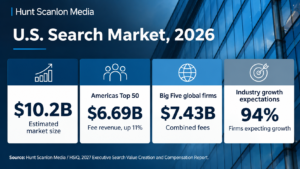
The U.S. retained executive search market is estimated at approximately $10.2 billion in 2026, reflecting a contraction of roughly two to three percent annually since 2021. Yet fee revenue among the 50 largest search firms in the Americas climbed 11 percent to $6.69 billion, with three-quarters of ranked firms reporting growth and nearly half expanding by double digits.
Meanwhile, the industry’s five largest global firms — Korn Ferry, Spencer Stuart, Heidrick & Struggles, Russell Reynolds Associates, and Egon Zehnder — generated a combined $7.43 billion in fees, marking their strongest year on record, according to the study.
The findings point to an increasingly bifurcated market. While elevated interest rates and softer senior-level hiring have pressured smaller and mid-market firms, larger organizations have benefited from their scale, established client relationships, diversified services, and investments in technology.
Related: Private Equity Takes a Harder Look at Leadership Assessment
The report also identified profitability as a growing concern. Recruiterflow’s observations across its client base suggest that revenue has remained relatively resilient even as net income has declined, placing additional pressure on compensation expenses and operating margins.
AI Reshapes Productivity and Search Economics
Artificial intelligence is emerging as one of the most significant forces changing the economics of executive search. The report found that firms using AI-assisted sourcing are completing C-suite searches approximately five weeks faster than those without comparable capabilities, with typical timelines falling from roughly 14 weeks to nine weeks in some tracking.
 2027 Executive Search Value Creation and Compensation Report
Executive search is entering a new era of growth and transformation. As AI reshapes productivity, firms rethink their operating models, and competition for leadership talent intensifies, the relationship between compensation, performance, and value creation is changing.
Developed by Hunt Scanlon Media, with Recruiterflow as lead sponsor, the Executive Search Value Creation and Compensation Report 2027 examines how executive search firms are compensating their people, measuring performance, and adapting to a rapidly evolving industry. The report explores compensation benchmarks across firm sizes and seniority levels, emerging incentive structures, and the growing importance of capabilities, specialization, and technology in determining professional value.
Download the full report to explore compensation benchmarks, understand how leading firms are adapting their business models, and gain insight into the trends shaping executive search in 2027 and beyond.
Firms deploying AI-assisted sourcing are also reportedly 3.5 to 4.5 times more likely to grow revenue than organizations that have not adopted the technology. Yet the research identifies a substantial gap between access to AI tools and their integration into everyday operations.
A Hunt Scanlon and Recruiterflow survey of 97 executive search firm leaders found that 91 percent were already using general-purpose AI assistants such as ChatGPT or Claude. However, only 20 percent had achieved broad adoption across multiple workflows, while 58 percent reported moderate adoption and another 20 percent remained in the experimental stage.
The report describes this divide as the AI integration gap. Firms that have embedded AI throughout their operating models are beginning to demonstrate measurable advantages over competitors using the technology primarily for isolated tasks.
Among firms with broad AI adoption, 62 percent reported revenue growth at or above the industry average, compared with 48 percent of moderate adopters. The findings suggest that the competitive advantage increasingly comes from integrating technology into established workflows rather than simply providing employees with access to AI tools.
Leadership also plays a central role in determining adoption. The research found that 66 percent of respondents identified firm leadership as the primary driver of AI implementation, a figure that increased to 84 percent among broad adopters.
These developments raise important questions about productivity and compensation. As consultants complete more assignments without proportional increases in staffing, firms must determine how the resulting economic benefits should be distributed among individual producers, teams, and the broader organization.
Compensation Models Face Growing Pressure
The traditional commission-based compensation model is also facing increasing scrutiny as executive search firms rethink how value is created and rewarded.
Historically, compensation has been closely tied to individual production, with consultants receiving commissions or bonuses based on the searches they originated and completed. While that approach remains important, the report found that modern search assignments increasingly depend on teams, shared research resources, technology platforms, assessment capabilities, and relationships across multiple practices.
As a result, firms are moving toward hybrid compensation structures that combine base salaries, individual production incentives, team bonuses, and firm-wide performance measures. Larger organizations are generally better positioned to offer substantial guaranteed compensation and long-term incentives, while boutiques continue to rely more heavily on commission-based arrangements.
The report also points to growing interest in equity participation, profit sharing, and long-term incentive plans as firms seek to retain senior producers and align compensation with enterprise value creation.
These changes are particularly relevant as private equity investment and industry consolidation reshape ownership structures. Compensation models increasingly must reward not only individual billings but also collaboration, intellectual property development, recurring revenue generation, and long-term client relationships.
New Revenue Opportunities Beyond Traditional Search
Another major finding is the growing importance of non-placement revenue as executive search firms expand beyond traditional retained and contingent assignments. Although placement fees remain the industry’s largest revenue source, the report identifies advisory, consulting, executive coaching, interim leadership, and talent intelligence as important areas of expansion.
Related: Search Leaders Have Mastered Prompting. Now They Want AI that Works for Them
Talent intelligence is emerging as a particularly significant opportunity. Rather than providing market mapping, compensation benchmarking, and organizational research exclusively as part of individual searches, firms are beginning to monetize these capabilities through standalone advisory engagements, subscriptions, and licensing arrangements.

The report describes this development as an emerging third model of executive search, extending beyond the traditional retained and contingent structures. Unlike placement fees, recurring talent intelligence revenue can continue even when clients are not actively conducting executive searches. This creates opportunities for more predictable revenue, stronger client relationships, and potentially higher enterprise valuations.
The study also found that firms expanding into advisory services are positioning themselves earlier in the leadership decision-making process, helping clients evaluate succession risks, assess leadership capabilities, and anticipate talent needs before a vacancy emerges.
Culture, Development, and Retention Become Competitive Priorities
Beyond compensation and financial performance, the report examines how workplace culture influences the ability of executive search firms to attract and retain employees.
One notable finding concerns firm size. Organizations generating between $51 million and $100 million in annual revenue received the strongest and most consistent employee feedback in Hunt Scanlon’s interviews. These firms appear to offer an effective balance between the resources of larger organizations and the accessibility, autonomy, and leadership engagement associated with smaller partnerships.
The study also examines nine workplace culture dimensions, including trust, leadership, respect, belonging, growth, flexibility, recognition, support, and hiring practices. Belonging and flexibility emerged as important areas requiring attention, reinforcing the need for firms to evaluate the employee experience beyond compensation alone.
Career development is another central retention issue. Limited opportunities for professional growth, unclear advancement paths, and insufficient investment in training can leave employees vulnerable to recruitment by competitors.
For high-performing consultants, researchers, and associates, compensation remains important, but culture, belonging, flexibility, leadership quality, and meaningful career opportunities increasingly influence decisions about whether to remain with an organization.
The report suggests that firms must move beyond traditional compensation packages toward a broader employee value proposition that combines competitive pay with professional development, recognition, ownership opportunities, and a supportive working environment.
Looking Ahead
As executive search enters 2027, the report concludes that the profession is undergoing a structural transformation extending well beyond compensation. AI is changing productivity expectations, new advisory services are expanding revenue opportunities, and firms are being challenged to reconsider how they measure individual and organizational performance.
For search firm leaders, the central question is no longer simply how much to pay their people, but how compensation, technology, development, and culture can work together to create sustainable growth.
The findings suggest that firms best positioned for the next phase of industry development will be those capable of combining advanced technology and talent intelligence with the judgment, relationships, and leadership expertise that remain central to executive search.
The 2027 Executive Search Value Creation and Compensation Report, sponsored by Recruiterflow, provides an extensive examination of these developments and their implications for executive search firms, corporate talent leaders, boards, and investors.
To download the report, click here!
Contributed by Scott A. Scanlon, Editor-in-Chief and Dale M. Zupsansky, Executive Editor – Hunt Scanlon Media