Search Leaders Have Mastered Prompting. Now They Want AI that Works for Them

November 5, 2026 – As artificial intelligence becomes more deeply embedded in executive search, firms are moving beyond basic adoption to determine how the technology can deliver measurable business value. The focus is increasingly shifting toward improving productivity, strengthening client relationships, and giving recruiters more time to concentrate on high-value activities. But realizing those benefits will require more than familiarity with AI tools, as firms look to translate individual experimentation into broader operational capabilities.
By now, most search consultants can prompt their way to a sharp client or candidate brief in seconds. Then they spend the next 20 minutes copying it into their ATS and emailing prospects. That’s where executive search is with AI: Hunt Scanlon Media’s own research found that 91 percent of search professionals already use general-purpose tools like ChatGPT and Claude. The harder question now is what comes after the chat window.

A new report from Ren, an AI-powered relationship intelligence platform for executive search and professional services, offers answers. Survey respondents described a clear gap between what they can do with AI today and what they want it to do next.
Prompting is Now Table Stakes
Among executive search respondents, 72 percent consider themselves experts at writing prompts to research companies, compare sources, and synthesize information. No other AI skill came close. Only 17 percent said they still want to get better at it. For most search professionals, prompting is a solved problem.
Source: Ren AI-powered dealmaking survey, executive search respondents, October 2026
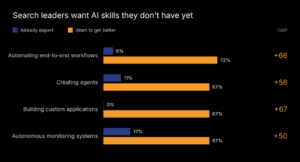
Ask about what comes after the prompt, and the picture changes. Search respondents reported low expertise but high interest in nearly every advanced AI skill. That appetite runs into a practical problem: the systems search firms run on need to be connected.
Specialized Tech Stack
Respondents named Bullhorn, Recruiterflow, Ezekia, Invenias, Loxo, Thrive, and PCRecruiter as their CRM or ATS, and only one named Salesforce. These specialized systems hold a search firm’s most valuable asset: its relationship and search history.
Related: Executive Search Continues Its Confident Climb As Transformation Takes Center Stage
But not a single search respondent said their current tools already meet their needs. Two-thirds (67 percent) want a better tool for prospecting and lead generation, and 61 percent want one for CRM and contact management. Asked for the one capability they most want from vendors in the next six to 12 months, respondents named integration more than anything else.
“[Ease] of integration. One single interface for seamless insights across platforms,” a VP at a mid-size firm wrote. A consultant put it plainly: “Integrating AI within the CRM (i.e. Copilot into Bullhorn).”
 millionways Brings a New Behavioral Intelligence Lever to Executive Recruiters
Hunt Scanlon Ventures has completed its investment in millionways, a New York-headquartered company that builds a behavioral intelligence layer of AI for human agent workforces, utilizing a proprietary Large Psychology Model called Thorsten-4. The platform focuses on understanding human signals, motives, and behavior patterns, with applications used across AI governance, executive hiring, talent management, and enterprise environments.
“millionways is a trailblazer in this newly emerging space,” said Scott A. Scanlon, CEO and co-founder of Hunt Scanlon Ventures and a senior advisor to company co-founders Martin Cordsmeier and Max Weidemann. “As investors, we see behavioral intelligence as a new layer of AI infrastructure, giving artificial intelligence a missing layer – the ability to interpret the human dynamics behind communication and decision-making. In our view, organizations that can better understand the convergence of leadership and human behavior patterns will create meaningful competitive advantage in the years ahead. Behavioral intelligence will become central to everyday enterprise decision-making,” he said.
The plumbing already exists. MCP (Model Context Protocol) is the standard plug that lets an assistant like Claude or ChatGPT work directly with a firm’s CRM or ATS, inbox, calendar, and data sources. Think of it as USB-C for AI, and most search CRM and ATS vendors now offer their own MCP connectors. With those connections in place, AI can take on more of the heavy lifting:
- Combine tools. A consultant asks for a warm intro to a prospective client, and the AI checks the firm’s relationship data for the best path in.
- Run on its own. Every morning, the AI pulls a partner’s priority clients from the CRM, gathers news on each, and emails a digest.
- Take action. When an executive in a consultant’s network changes jobs, the AI logs it in the ATS and creates a follow-up task, whether the move signals a new search or a new candidate.
The blank-canvas chatbot is a starting point, not the destination. Yet only about a quarter of search respondents (28 percent) consider themselves experts at connecting AI to their tools. The connectors exist. The question is who turns them on.
Bottom-Up Adoption
In search, the answer is usually the individual. Ren’s executive search respondents more often discover new AI tools through colleagues and industry events than through a firm-wide rollout. That makes adoption organic, but it also leaves individuals to find, connect, and keep up with each new tool on their own.
That tension came up at Ren’s September webinar with Hunt Scanlon Media, where panelists discussed firms stuck in “pilot purgatory” and overwhelmed by tool overload, as well as the growing need to connect purpose-built tools with existing CRM and data systems.
“That’s why the leadership role in search looks different,” Ren explained. “It isn’t picking the tool. It’s clearing the way: approving connections, choosing systems that can plug in, and scaling what consultants already find works. Search consultants don’t need more prompt training. They need the freedom to experiment with agents and automations, and the connections that let the best ideas spread across the firm.”
Related: Leveraging AI to Drive Business Development in Executive Search
Contributed by Scott A. Scanlon, Editor-in-Chief and Dale M. Zupsansky, Executive Editor – Hunt Scanlon Media