The New Engine of Executive Search: How Hunt Scanlon Is Powering a Productivity Revolution

April 14, 2026 – As the executive search industry confronts growing pressure to deliver consistent, high-level performance, recruiting firms are rethinking how their consultants are trained and developed. To that end, Hunt Scanlon and its HSiQ talent intelligence advisory unit last week began rolling out a new Recruiter Performance Training Program designed to bring greater structure, rigor, and scalability to recruiter performance. The initiative reflects a broader shift away from informal apprenticeship models toward systems designed to drive measurable outcomes across search organizations.
“At a time when executive search is undergoing a profound shift, the role of the recruiter is rapidly evolving,” said Richard Stein, CEO of HSiQ. “This training program is built specifically to meet that moment by developing the next generation of recruiters who can operate with greater precision, insight, and client impact in increasingly complex markets.”

This is not incremental change. It reflects a broader transformation in how value is created within the talent ecosystem. This is not training on databases, systems, or LinkedIn tactics, said Mr. Stein. It is grounded, real-world development focused on how talent decisions drive enterprise value led by someone who has spent an entire career advising CEOs and the C-suite on every aspect of their talent challenges. “There is nothing theoretical here; it is practical, experience-based, and built around what actually wins at every level of talent acquisition,” he said.
Unlocking Existing Value
Historically, performance in executive search and across talent acquisition teams has been uneven and dependent on individual producers, resources, informal training, and institutional knowledge that is difficult to scale. Hunt Scanlon’s model challenges that paradigm by introducing structured systems, repeatable methodologies, and embedded intelligence that can be deployed across an entire firm.
 Hunt Scanlon Launches Training Program for Executive Recruiters
The executive search industry has a training problem. For decades, recruiting firms have relied on apprenticeship models, learning by osmosis, informal coaching, and individual manager styles. It works for a few. But it does not scale. In a market now defined by AI, speed, precision, and commercial pressure, inconsistency in recruiter performance is no longer a tolerable inefficiency but a direct constraint on growth. Hunt Scanlon, in partnership with its HSiQ talent intelligence advisory unit, today announces the launch of the firm’s Recruiter Performance Training Program – a structured, 10-session training module designed to boost recruiter productivity, performance, and revenue generation skills.
“At a time when executive search is undergoing a profound shift, the role of the recruiter is rapidly evolving,” said Richard Stein, CEO of HSiQ. “This training program is built to meet that moment by developing the next generation of recruiters who can operate with greater precision, insight, and client impact in increasingly complex markets.”
The result is consistency – arguably the most elusive and valuable lever in the industry. “We are unlocking value that already exists inside search organizations but has never been systematically activated,” said Scott A. Scanlon, CEO of Hunt Scanlon and co-founder of HSiQ. “Our methodology is built on structured training, repeatable systems, and measurable outcomes and offers a high ROI for executive search firms and talent acquisition teams across all industries.”
Driving Higher Productivity Per Recruiter
The timing is critical. As AI, data, and talent intelligence reshape the competitive landscape, search firms and talent acquisition teams are being forced to rethink their operating models. Clients are demanding more than candidate delivery and are demanding far greater insight, advisory, and precision. At the same time, search firms as well as corporations and financial institutions must drive higher productivity per recruiter as traditional leverage models come under pressure.
Related: Hunt Scanlon Launches HSiQ Talent Intelligence Advisory Unit
Hunt Scanlon’s approach aligns directly with this shift. By embedding training into live workflows where recruiters apply learning directly to active mandates, the program turns development into immediate commercial impact. It spans the full lifecycle of talent acquisition from business development and client advisory to candidate assessment and execution, while integrating modern tools, data, and AI.
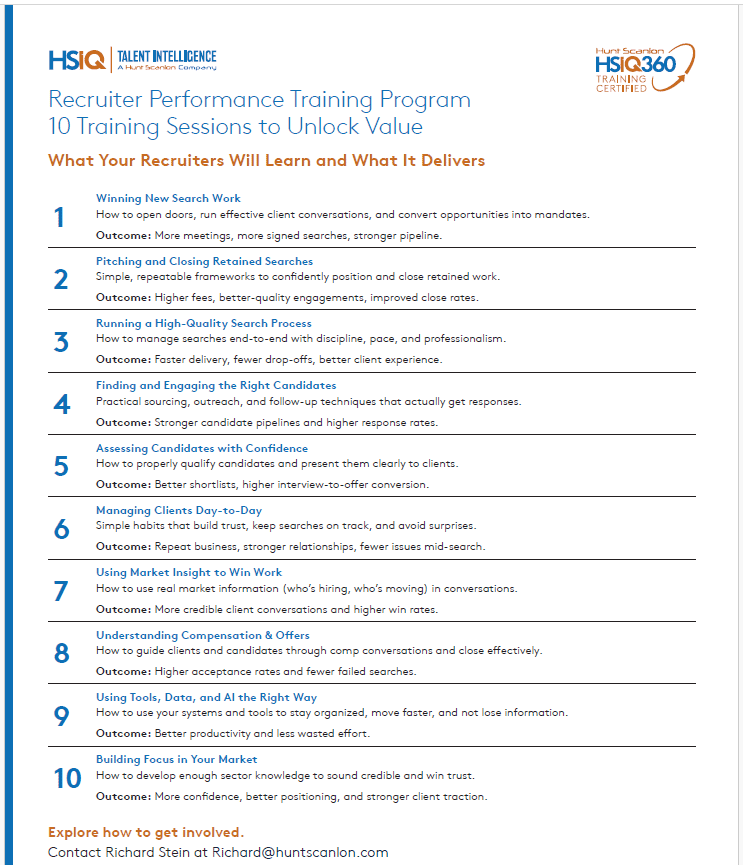
“Importantly, it is designed for the entire firm not just new entrants, but experienced consultants seeking to operate also at a higher level. This signals a move toward institutional capability over individual performance. Firms that embrace this model are not just training recruiters but are building operating systems,” said Mr. Scanlon.
In a market increasingly defined by complexity, speed, and intelligence, those systems may prove to be the ultimate competitive advantage.
The program also has clear relevance for corporate talent teams, particularly in private equity and high-growth environments where hiring directly impacts enterprise value.
The Hunt Scanlon Annual Compensation Report, which be released in November will highlight how those firms investing in structured training are seeing stronger productivity, higher margins, and more consistent outcomes positioning training as a core lever in future compensation and performance models.
Related: Where The Next Trillions Will Be Won Among Executive Search Firms
Contributed by Scott A. Scanlon, Editor-in-Chief and Dale M. Zupsansky, Executive Editor – Hunt Scanlon Media, Richard Stein, CEO – HSiQ