Hunt Scanlon Launches Training Program for Executive Recruiters

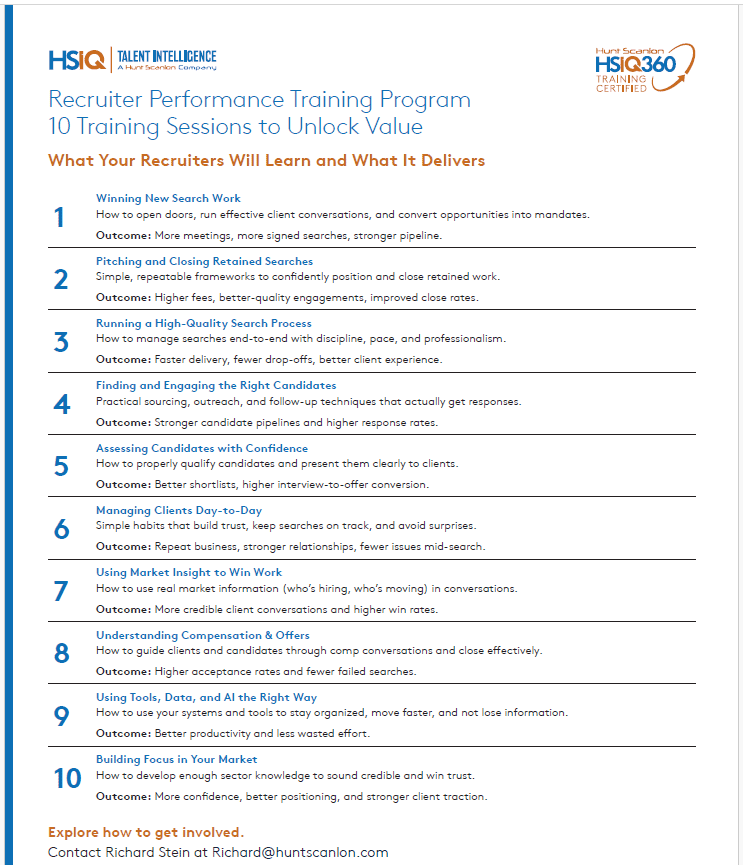
April 9, 2026 – The executive search industry has a training problem. For decades, recruiting firms have relied on apprenticeship models, learning by osmosis, informal coaching, and individual manager styles. It works for a few. But it does not scale. In a market now defined by AI, speed, precision, and commercial pressure, inconsistency in recruiter performance is no longer a tolerable inefficiency but a direct constraint on growth. Hunt Scanlon, in partnership with its HSiQ talent intelligence advisory unit, today announces the launch of the firm’s Recruiter Performance Training Program – a structured, 10-session training module designed to boost recruiter productivity, performance, and revenue generation skills.
“At a time when executive search is undergoing a profound shift, the role of the recruiter is rapidly evolving,” said Richard Stein, CEO of HSiQ. “This training program is built to meet that moment by developing the next generation of recruiters who can operate with greater precision, insight, and client impact in increasingly complex markets.”

“We are unlocking value that already exists inside search organizations but has never been systematically activated,” said Scott A. Scanlon, CEO of Hunt Scanlon and co-founder of HSiQ. “Our methodology is built on structured training, repeatable systems, and measurable outcomes — and offers a high ROI for executive search firms. It will fundamentally change the economic trajectory of every firm that embeds our training methodologies.”
Companies that invest in training report up to 47 percent higher profit margins and 86 percent better company value. “Those metrics are indisputable and important for the search industry to note,” Mr. Scanlon added.
Mr. Scanlon said the HSiQ training program will add rigor to every recruiter’s toolkit. “It is designed for everyone – new entrants, junior consultants, and seasoned professionals looking to brush up on their skillsets in the modern age of AI,” he said.
The program introduces a structured curriculum spanning business development, client advisory, candidate assessment, market intelligence, and execution excellence designed to elevate recruiters into strategic operators. The 10-session, cohort-based program is staged throughout the year and delivered in a format that integrates seamlessly into the workday.
“Participants never have to leave their office and they can apply their learning directly to live mandates,” said Mr. Stein. “This is designed to drive consistency of execution across all levels, from junior consultants to partners, while building a shared commercial language across the firm.”
“This is not training for training’s sake,” added Mr. Stein. “It is not the usual database systems training that happens in the first few weeks of onboarding. It is, instead, a commercial engine built to increase productivity, accelerate revenue generation, and create sustained competitive advantage.”
The Recruiter Performance Training Program is being introduced to U.S. search firms this month, followed by a broader rollout to firms in the U.K., and Europe.
From Apprenticeship to Performance System
Most search firms do not lack talent. They lack a systematic way to enable performance. “The traditional model depends on individual leaders to develop people, resulting in uneven capability, inconsistent execution, and wide performance dispersion across teams,” says Mr. Stein. “High performers emerge in spite of the system, not because of it, but in low numbers.”
“Our training program introduces a codified performance model – one that can be deployed consistently across offices, teams, and geographies,” he says. “It shifts training from an informal activity to a certified, core operating lever. The Recruiter Performance Training Program is a cohort-based, 10-session course staged throughout the year designed to train recruiters to operate at consistently high levels of performance. It applies across the entire organization, from junior consultants through to partner, creating a shared standard of execution and a common commercial language across the firm.”
“Our training program introduces a codified performance model – one that can be deployed consistently across offices, teams, and geographies. It shifts training from an informal activity to a certified, core operating lever.”
The program is anchored in three core disciplines: 1) execution rigor (how work actually gets done at a high level); 2) client development (how mandates are originated and expanded); and 3) conversion discipline (how searches are closed efficiently and effectively).
Earning a Gold Standard Benchmark Credential
“Recruiters who complete the program will earn training certificates, establishing formal recognition of their achievement and expertise in the field,” says Mr. Scanlon. “Our certification will acknowledge that a gold standard benchmark credential has been earned and established.”
Related: Hunt Scanlon Launches HSiQ Talent Intelligence Advisory Unit
“This is not conceptual training,” says Mr. Stein. “It is practical, immediately applicable, and embedded into live workflows – driving measurable outcomes in productivity, client impact, and fee generation.”
Mr. Stein, who will lead the new offering, is one of the industry’s most prolific billing consultants over the past 25 years and an ardent proponent of basic bootcamp training. He built one training program that helped scale a search firm from $25 million to over $100 million in under seven years with marginal increase in headcount.
Linking Training to Performance Economics
Hunt Scanlon and HSiQ are rolling out the Recruiter Performance Training Program module alongside the firms’ compensation intelligence work to create a more complete performance model for the industry, linking how recruiters are trained with how they are rewarded. “Performance is not driven by one or the other,” says Mr. Stein. “It is driven by both.”
“For years, search firms have focused on incentives as a primary recruitment and retention lever,” says Christopher W. Hunt, president of Hunt Scanlon and co-founder of HSiQ. “But incentives without capability only amplify inconsistency,” he notes. “Training and compensation have to work together as a system.”
Mr. Stein recently sat down with Hunt Scanlon to discuss why the new Recruiter Performance Training Program comes at a critical moment for the executive search industry and how it is designed to address widening gaps in recruiter performance and capability!
 Richard, why is this program so important right now?
The executive search industry is in the middle of what we call “The Big Shift.” The role of the recruiter today is being fundamentally redefined from transactional execution to strategic advisory. However, the operating model has not caught up. Most firms are still relying on outdated apprenticeship models or, worse, no real training at all, just a “spray and pray” approach to business development. That gap is now a direct constraint on growth. At HSiQ, we see this clearly in the data. Firms don’t have a talent problem but rather a performance activation problem. This program is designed to solve that. It builds capability systematically across junior, mid-level, and even partner ranks because experience alone is no longer a proxy for relevance in a rapidly changing market.
You have said this is not traditional training. What makes it different?
Traditional training is largely theoretical focused on onboarding, tech tools, or internal process. This is different. This is performance enablement. We are teaching recruiters how to win, how to originate mandates, operate as trusted advisors in the room, and convert opportunities at a consistently high level. Moving upstream is critical because AI is commoditizing execution, and if you stay downstream, you are no longer shaping decisions but are reacting to them. Firms that operate upstream define the mandate, influence the outcome, and lead the conversation while those that don’t risk being disintermediated entirely. It is about reverse engineering searches before they even exist shaping client thinking, not just responding to it. Everything is practical, embedded in live workflows, and tied directly to revenue outcomes. If it doesn’t drive performance, it doesn’t belong in the program.
“We are teaching recruiters how to win, how to originate mandates, operate as trusted advisors in the room, and convert opportunities at a consistently high level.”
The program emphasizes structure. Why is that so critical?
Without structure, performance doesn’t scale. Right now, most firms rely on a handful of top billers or individual manager styles. That creates inconsistency across teams, offices, and geographies. It is the first thing clients or potential clients notice first. What we are introducing is a codified performance system one that standardizes how recruiters think, operate, and execute. This is how firms move from isolated pockets of excellence to enterprise-wide performance. In today’s market, that shift is the difference between growth and stagnation.
How does the delivery model fit into a recruiter’s day-to-day reality?
It is designed to integrate seamlessly into the flow of work, not disrupt it. The program is staged throughout the year, with participants committing just two hours a day, five days a week without ever leaving the office. What they learn is immediately applied to live searches, real client situations, and active business development. There is mentorship, real-time problem solving, and continuous feedback. This is not training as an event. It becomes part of how the firm operates 24/7.
What is the ultimate impact for firms that adopt this?
It is simple: unlocking hidden value. Most firms are sitting on significant unrealized productivity. The talent is there but it’s not fully activated. When you align training with execution, client development, and conversion discipline, you see measurable gains in revenue, productivity, and client impact. The firms that win in this next era will not be the ones with the most people. They will be the ones that can build performance systematically across every desk. That’s exactly what this program is designed to do.
Related: Where The Next Trillions Will Be Won Among Executive Search Firms
Contributed by Scott A. Scanlon, Editor-in-Chief and Dale M. Zupsansky, Executive Editor – Hunt Scanlon Media, Richard Stein, CEO – HSiQ