Workforce Trends 2026: Leaders Confront Burnout, Disengagement, and AI-Driven Change

November 26, 2025 – As we look ahead to 2026, global business leaders are navigating a shared set of challenges: employee engagement is declining, burnout is rising, and the pace of change—driven by economic uncertainty, AI advancements, and evolving work models—continues to accelerate. DHR Global’s second annual Workforce Trends Report recently surveyed global leaders to understand how these forces are reshaping the workplace, and to identify actionable strategies for sustaining engagement and retention.
While regional nuances exist, the findings reveal a universal truth: Culture is a powerful driver of engagement and adaptability, according to the DHR report. Organizations that prioritize flexibility, invest in development, and lead with authenticity are better equipped to navigate today’s complexity and build a more resilient future.

Culture is the bedrock of every organization. Nearly all respondents say their workplace culture is somewhat (40 percent) or very (53 percent) important to their employee experience. But only 36 percent of workers feel their company culture is well-defined and drives performance, with many instead describing it as reactive and inconsistent across teams (46 percent) or vague and not actively shaped (15 percent).
“Long gone are the days when most employees worked together in offices, where shared routines and spontaneous conversations shaped culture naturally,” the DHR report said. “Now, employees in more distributed work environments value meaningful recognition and autonomy over office perks or social events.”
While 77 percent of C-suite leaders say culture is “very important,” only 37 percent of entry-level employees feel the same. Executives are also 2.5x more likely than entry-level staff to view their company’s culture as well-defined. Leaders may set the vision, but culture only thrives when employees buy in and actively participate. Even the most strategic cultural initiatives fall flat without that connection.
How Employers Can Enhance Work Experience
Recognition and flexibility top DHR’s list of what employees say would most improve workplace culture today. This emphasis on recognition also shows up in burnout data: the share of employees citing lack of reward or recognition as a top burnout driver nearly doubled since last year, from 17 percent to 32 percent.
The call for a more effective workplace culture runs deep. Nearly one-third of respondents (31 percent) chose “a stronger, more purposeful workplace culture” as one of the top three improvements they want from their employer over the next year. The DHR report explained that with culture no longer anchored by office routines, leaders must work to make it tangible for employees through visible recognition, real flexibility, and values practiced daily. Lasting and scalable company culture also requires active, meaningful employee participation.
“Leaders can nurture workplace culture by building recognition programs that reach every level, tailoring flexibility to the needs of different teams and regions, and modeling the culture they want to see,” the DHR report said. “Leaders can also make culture a shared responsibility by inviting input and contributions from employees.”
The New Retention Risk
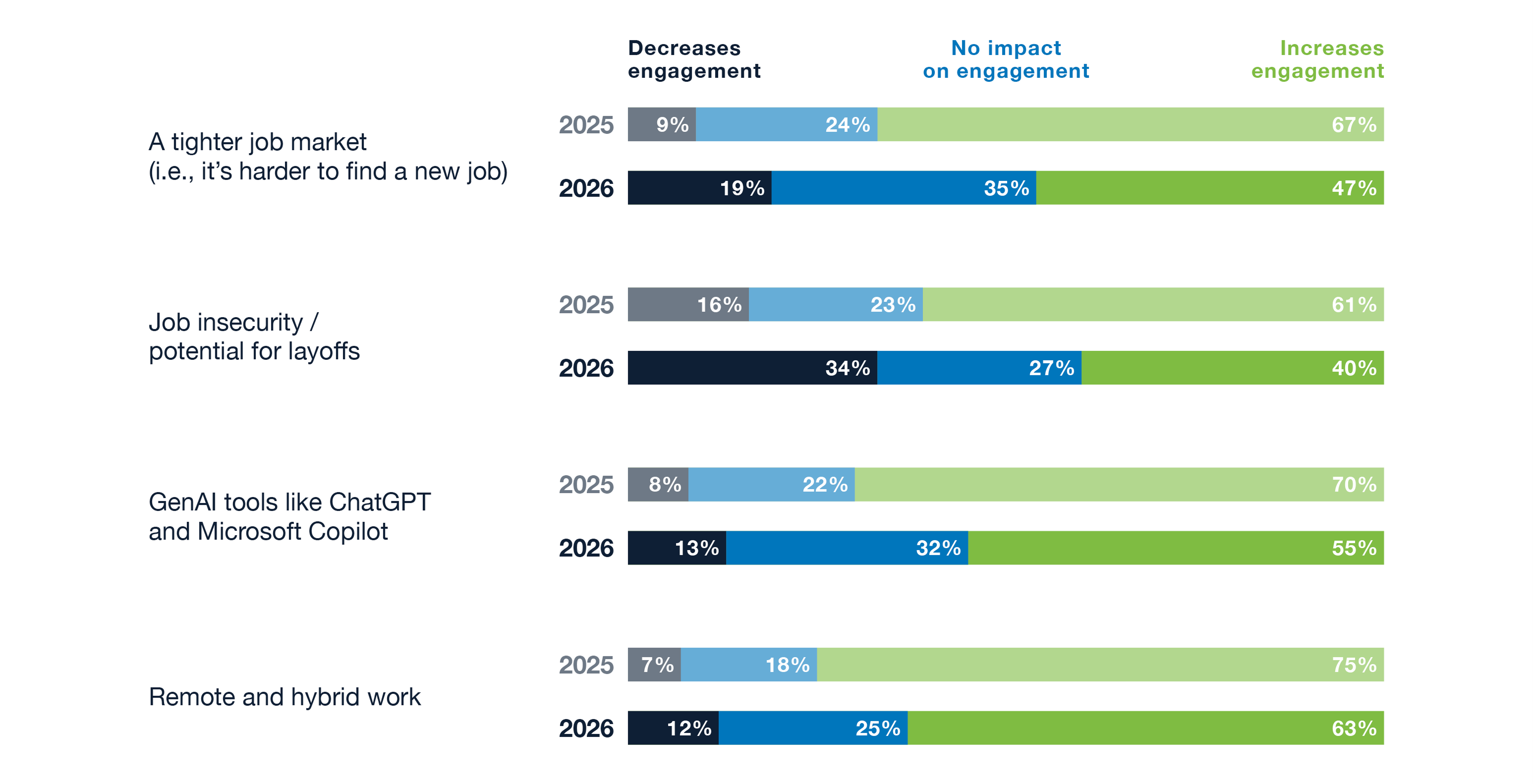
Employee engagement has dropped significantly year-over-year, with just 64 percent of workers describing themselves as very or extremely engaged — down from 88 percent in 2025. This trend is consistent across regions, with engagement lowest in Asia (59 percent), and slightly higher in North America (67 percent) and Europe (68 percent). Professional development continues to be the top driver of engagement (71 percent), ahead of remote/hybrid work (63 percent) and GenAI tools (55 percent).
“Yet, as flexible work and AI become standard realities, their positive impact on engagement is fading,” the DHR report said. “Many employees are feeling the strain as the novelty of flexible work and AI diminishes and job security grows less certain more broadly.”
Drivers and Hindrances to Employee Engagement, 2025 vs. 2026
As engagement declines, burnout remains a major challenge among employees, with DHR finding that 83 percent of workers feeling at least some degree of burnout, consistent with 2025 (82 percent). The issue is most pronounced in the retail (62 percent), tech (58 percent), and healthcare (61 percent) industries, where moderate to extreme burnout is highest. Overwhelming workloads (48 percent) and working too many hours (40 percent) top the list of causes for respondents across all regions.
What’s Fueling Persistent Burnout?
DHR also said that it’s worth noting that while burnout rates are holding steady, burnout’s influence on engagement has grown: 52 percent of workers say burnout drags down engagement, up from 34 percent in 2025.
Despite higher levels of burnout among workers, tech leads all sectors in engagement, with 78 percent of employees reporting they’re very or extremely engaged. Nearly half of tech workers (48 percent) say their workplace culture is well-defined and actively shapes their experience, suggesting that a strong company culture may be helping sustain the industry’s above-average engagement rate.
Related: Executive Hiring Tightens Now, Sets Stage for Selective Rebound in 2026
Burnout also hits some employee groups harder than others. Associates (62 percent) and entry-level employees (61 percent) are the most likely to report reduced engagement due to burnout, compared to just 38 percent of C-suite leaders, 55 percent of VPs, 44 percent of directors, and 48 percent of managers.
Failing to address burnout head-on risks not only eroding employee morale and productivity, but also losing key talent, DHR explained. The turnover of high-performing employees creates additional hurdles for organizations, with 91 percent of respondents saying that the loss of high-performing colleagues impacts the organization.
“Declining engagement and persistent burnout call for decisive action,” the DHR report said. “The focus should be on building strong workplace connections and communication so every employee feels valued and motivated. Leaders must prioritize managing workloads and hours to address top burnout drivers, and invest in professional development to boost retention. It’s particularly important to pay close attention to early-career employees, who are especially vulnerable to disengagement.”
The Rise of AI
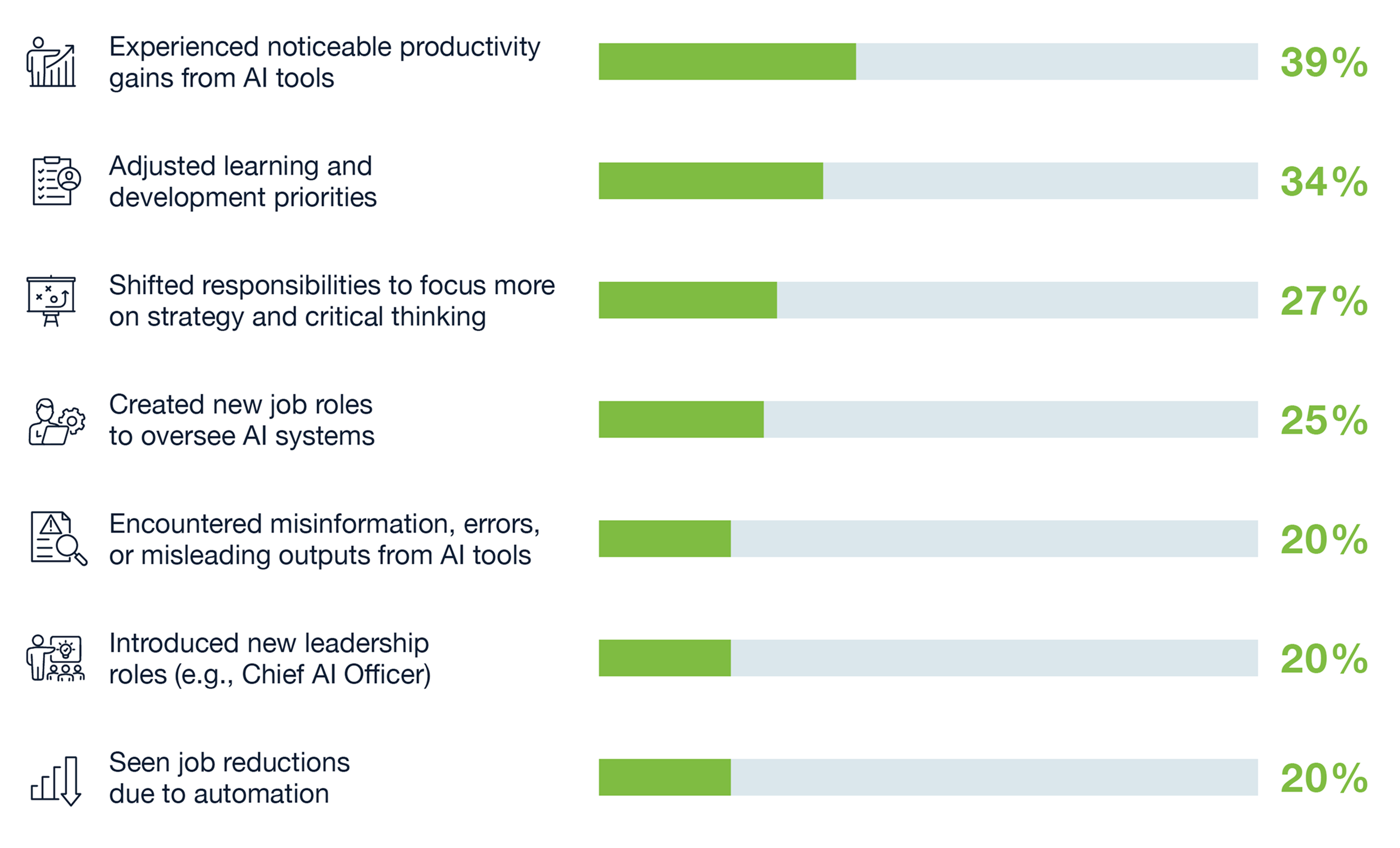
AI has quickly become a fixture in the modern workplace. Over the past year, 39 percent of employees reported noticeable productivity gains from AI tools, with the highest impact in Asia (44 percent), followed by Europe (40 percent) and North America (33 percent). Organizations are responding by adjusting learning and development priorities (34 percent), shifting more responsibilities to strategy and critical thinking (27 percent), and creating new roles to oversee AI systems (25 percent).
AI’s Impact on Organizations Over the Past 12 Months
 Despite AI’s growing influence, most employees are still waiting for guidance on what the technology means for their daily roles and skills, according to the DHR report. Only 34 percent say their organization has already communicated this information “very clearly.”
Employee appetite for leadership direction is strong, with 24 percent of workers ranking a clear plan for how AI will affect their job among the top three changes they want this year.
Without this guidance, DHR noted that employees have had to decide on their own which skills feel valuable for career growth in the age of AI. Most are prioritizing deep expertise in a specific area (35 percent), while others are focusing on broader cross-functional knowledge (29 percent), soft skills like communication and leadership (22 percent), or AI and data literacy (13 percent).

Clear communication around AI adoption makes all the difference. Case in point, tech. Half of employees (52 percent) working in tech say their company has been very clear about AI’s impact, the highest of any sector surveyed. Tech employees are also most likely to report a significant engagement boost from GenAI tools (37 percent, versus 14-23 percent in other sectors), signaling a clear line between AI strategy and benefits.
While 69 percent of C-suite leaders and 51 percent of VPs say their organization has communicated very clearly about AI, only 12 percent of entry-level staff and 22 percent of associates agree. The divide shows up in engagement, too: 74 percent of C-suite leaders report higher engagement because of GenAI, compared to just 27 percent of entry-level employees. DHR explained that leaders may believe they’re communicating clearly, but most employees aren’t hearing it, putting successful AI adoption and engagement at risk.
“AI is rapidly transforming work, but most employees still lack guidance on how the technology will affect their roles and skills, particularly early-career employees,” the DHR report said. “The answer lies in proactive and clear communication. To realize the full value of AI, leaders should focus on transparent, consistent messaging and give employees at every level a prescriptive roadmap for adapting and growing alongside new technology.”
Related: CHRO Perspectives: Looking Ahead to 2026
Contributed by Scott A. Scanlon, Editor-in-Chief and Dale M. Zupsansky, Executive Editor – Hunt Scanlon Media