Leadership Advisory Enters a New Capital Cycle

July 1, 2026 – Private capital is making one of its strongest moves yet into the leadership advisory sector. Recent investments by KKR in ghSMART and Advent International in Heidrick & Struggles represent more than headline transactions. Together, they signal a growing conviction among investors that leadership advisory firms occupy a unique position within the modern enterprise, helping organizations navigate leadership succession, organizational effectiveness, talent assessment, and increasingly, AI-driven workforce transformation.
For decades, many of the industry’s most influential firms operated outside the traditional private equity playbook, growing through partner ownership structures, long-term client relationships, and specialized expertise.
That dynamic is beginning to change as investors increasingly view leadership advisory as an attractive category within professional services, one defined by recurring client relationships, strong intellectual capital, and growing demand from both corporate boards and private equity sponsors.
Why Investors Are Paying Attention
Leadership decisions have never carried greater consequences. Across industries, organizations are confronting rapid technological disruption, shifting workforce expectations, and increasing pressure to deliver growth in uncertain environments. As a result, boards, CEOs, and investors are relying more heavily on leadership advisors to help evaluate talent, succession, organizational effectiveness, and executive performance.
This growing strategic importance is changing how investors view the sector.
“Leadership advisory firms occupy a unique position within the human capital ecosystem because they directly influence many of the decisions that ultimately determine organizational performance,” said HSV managing director Drew Seaman, managing director “As companies place greater emphasis on leadership quality and workforce strategy, demand for these capabilities continues to grow.”
AI Is Reshaping Assessment and Advisory
One of the report’s most compelling themes is the growing role of AI in talent assessment and leadership intelligence. While executive search and advisory firms have historically relied on experience, judgment, and relationships, technology is beginning to augment those capabilities through workforce analytics, assessment tools, predictive insights, and decision-support systems. This evolution is attracting investor attention.
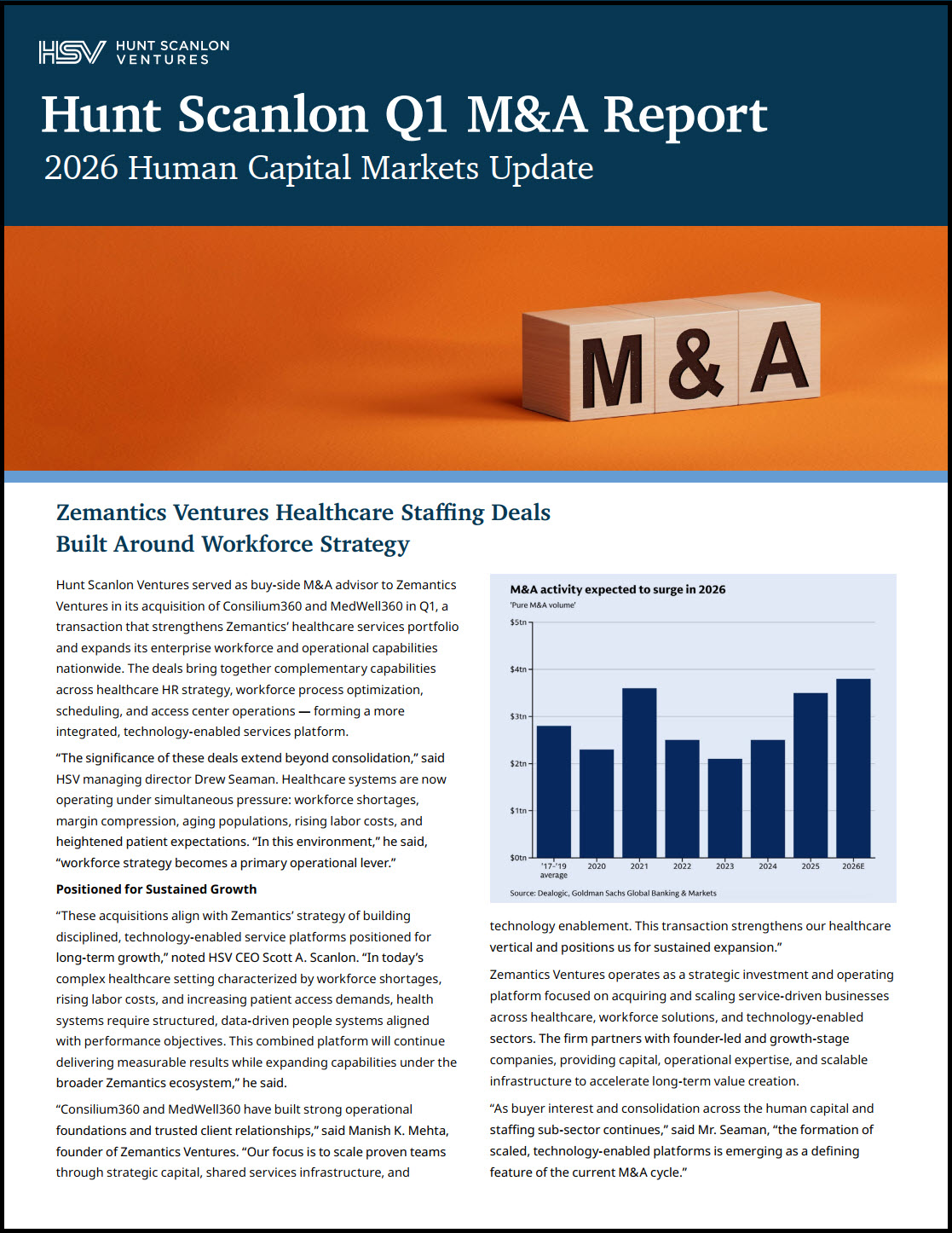 Hunt Scanlon Ventures 2026 Q1 M&A Report
Hunt Scanlon Ventures has just released its latest Q1 M&A Report, offering an in-depth look at the forces reshaping the global human capital sector in 2026. Download the free PDF to explore the latest M&A activity, emerging investment themes, and strategic trends driving executive search, leadership advisory, and talent intelligence markets.
Whether you’re evaluating a potential acquisition, preparing your firm for a strategic capital event, or tracking broader market activity across the talent ecosystem, this report delivers timely market intelligence and actionable insights into one of the fastest-evolving segments of professional services. Click here to download the report!
“Artificial intelligence is creating entirely new opportunities within leadership assessment and talent intelligence,” said Mr. Seaman. “The firms that can combine deep advisory expertise with data-driven insights are building capabilities that become increasingly valuable over time.”
Rather than replacing advisors, AI is enhancing their ability to evaluate leadership potential, identify organizational risks, and provide more actionable recommendations to clients. As these capabilities mature, firms with strong data assets and technology infrastructure may command increasingly attractive valuations.
The Competitive Landscape Is Changing
The arrival of institutional capital also introduces new competitive dynamics to the industry. Historically, the largest privately held firms operated with limited external investment and focused on steady, relationship-driven growth. Access to private equity capital creates opportunities to accelerate expansion, invest in technology, and broaden service offerings. That shift could reshape the competitive landscape.
Related: KPMG Finds Success in M&A Remains Stacked Against Acquirers. Here’s Why.
“The firms attracting capital today are not simply executive search firms,” said Mr. Seaman. “They are increasingly becoming integrated leadership advisory platforms with broader capabilities spanning assessment, coaching, succession planning, and talent intelligence.”
As firms expand beyond traditional search work, the distinction between executive search, leadership advisory, and talent intelligence continues to blur. Clients increasingly expect partners that can support leadership decisions across the full talent lifecycle, not just during hiring processes.
Preparing for the Next Wave
The report also suggests that these transactions may represent the beginning rather than the end of a larger trend. As investors become more familiar with the economics of leadership advisory and as firms continue building scalable operating models, competition for high-quality platforms is expected to intensify.
At the same time, many founder-led firms are investing more heavily in infrastructure, recurring advisory services, and technology capabilities as they position themselves for future growth or strategic transactions.

This reflects a broader maturation of the sector. Leadership advisory is increasingly being viewed not as a collection of boutique practices, but as a strategic category within professional services capable of generating long-term value.
What This Means for Human Capital
The growing flow of capital into leadership advisory reflects a broader recognition that talent and leadership have become central drivers of enterprise performance. As organizations navigate AI disruption, workforce transformation, and increasing competitive pressure, the ability to assess, develop, and deploy leadership effectively is becoming more valuable than ever.
For investors, this creates a compelling opportunity. For leadership advisory firms, it creates new pathways for growth and innovation. And for the broader human capital sector, it signals an important shift.
The future of leadership advisory may not be defined solely by who has the strongest relationships. It may increasingly be defined by who can combine leadership expertise, technology, and talent intelligence into scalable platforms capable of shaping the next generation of organizational performance.
Related: M&A Becomes a Capability-Driven Acquisition Strategy
Contributed by Scott A. Scanlon, Co-CEO, Evan Berta, associate – Hunt Scanlon Ventures