AI Adoption Linked to Stronger Revenue Growth Across Executive Search Firms

March 12, 2026 – Macroeconomic conditions were unpredictable and labor markets remained sluggish in 2025, but many firms were able to find success in this challenging market. One way was with AI, which revolutionized the recruitment industry in 2025. Top-performing firms are four times as likely to be using AI, and 55 percent have seen KPIs increase more than 25 percent because of AI screening alone, according to Bullhorn’s 16th annual GRID Industry Trends Report. Bullhorn surveyed nearly 2,300 recruitment industry professionals across industries and around the globe to understand the most effective strategies in the field today.
In 2025, the report found that financial performance was surprisingly positive across the recruitment industry. Fifty-six percent reported revenue growth, compared to 40 percent last year. And 13 percent actually saw revenue increase by more than 25 percent year over year.

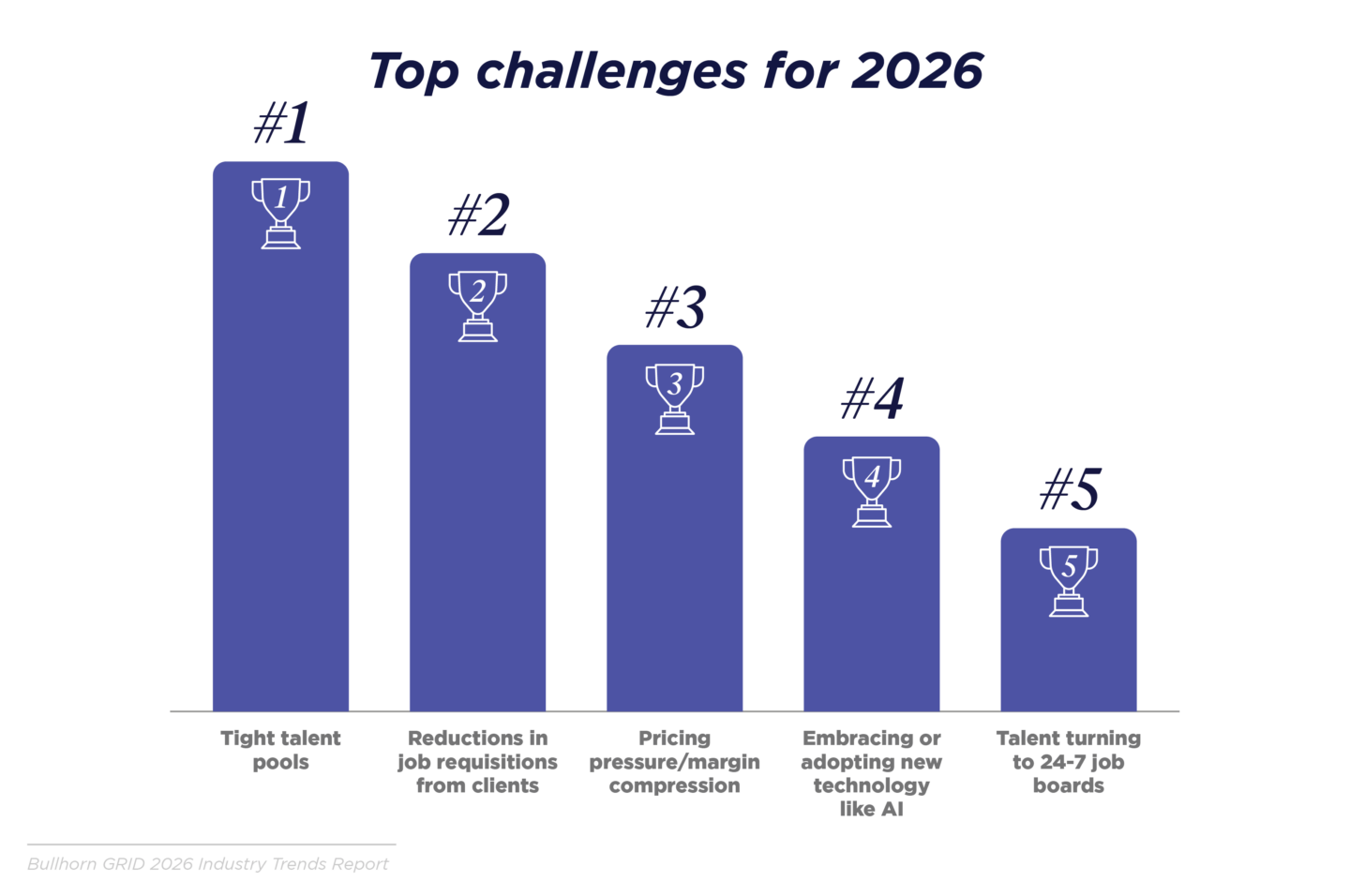
For a third year, Bullhorn found that firms identify the paradox of tight talent pools and falling job volumes as their top challenges for 2026, which aligns with them saying that hiring freezes and budget constraints are the biggest obstacles to winning new business. Against that backdrop, it is no surprise that the top priorities for recruitment leaders all relate to using AI to improve financial and operational performance.
Leaders’ top strategy to preserve financial performance in 2026 is to improve productivity through technology, according to the Bullhorn report. This strongly aligns with their commitment to AI and optimizing technology in 2026. And the leaders Bullhorn spoke with shared that really focusing on where they can compete and what new services they can provide is part of how they are doing more with less, which significantly raises the bar for productivity and strategic focus.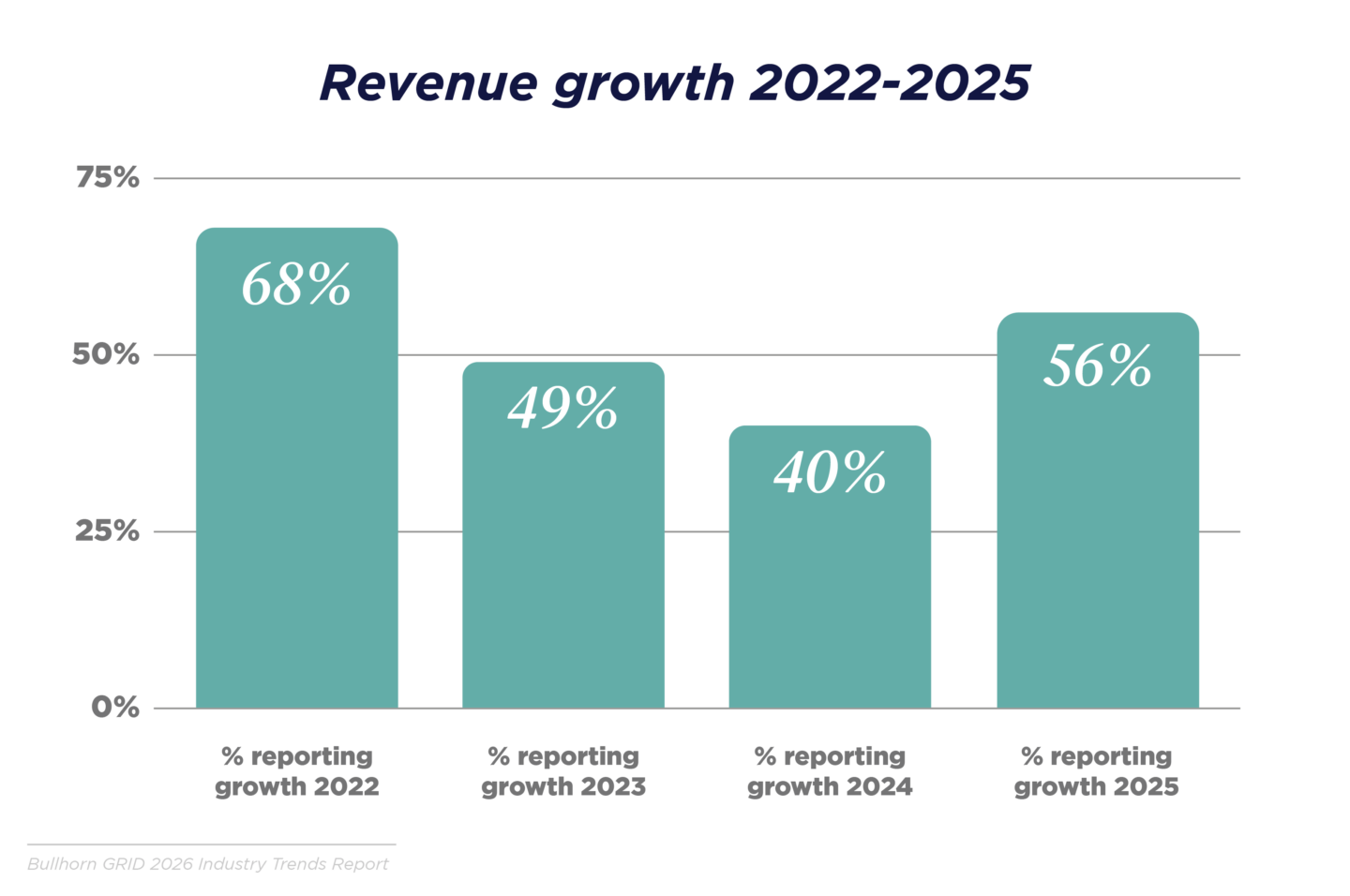
Firms that increased revenue in 2025 had much higher AI adoption rates than those that saw revenue decline. “And the industry as a whole has come a long way in terms of AI,” the report said. “With almost everyone now using AI to some degree, competition between firms is increasing; competition from other firms is now the second biggest obstacle to winning new business and a growing concern in this year’s data. The most successful firms are implementing AI throughout the workflow and leveraging it in ways that make them faster than the competition and retain their unique differentiation.”
AI Adoption has Increased Significantly
Last year, the majority of firms (52 percent) were only experimenting with basic generative AI tools. This year, Bullhorn found that only 29 percent are still in the generative AI category, and 30 percent have moved to some level of agentic AI tools.
Firms with the best revenue performance in 2025 were the most likely to be using automation and AI. And firms that saw revenue decline by more than 10 percent were the most likely to say they aren’t yet using AI, the Bullhorn report found. Firms using AI at any stage of the recruitment process are 3.5-4.5 times more likely to have grown revenue. Last year, firms using AI at any stage were only 25-40 percent more likely to have increased revenue, so the performance gap is growing between firms that are taking full advantage of AI solutions and those that are not.
Related: The Evolution of Executive Recruiting in the Age of AI
“It is not enough to simply have adopted AI; it matters that firms are using it in meaningful ways that yield tangible benefits,” the Bullhorn report pointed out. “Firms that are seeing the impact of AI on candidate screening and quicker recruiter ramp-up are reaping the financial benefits, making them as much as six times as likely to have increased revenue in 2025. And the highest growth firms are roughly 2.5 times more likely than any other group to be using AI in meaningful ways.”
Recruitment leaders rank the ability to scale without adding headcount and increased recruiter productivity as the top ways that AI is adding value to their organizations. This aligns with what was shared in Bullhorn’s conversations with recruitment leaders: simple generative AI point solutions are not enough; to truly see the benefits of AI, firms need to really focus on ROI and closely track the impact on KPIs. Basic generative AI and fragmented point solutions are not going to get the job done.
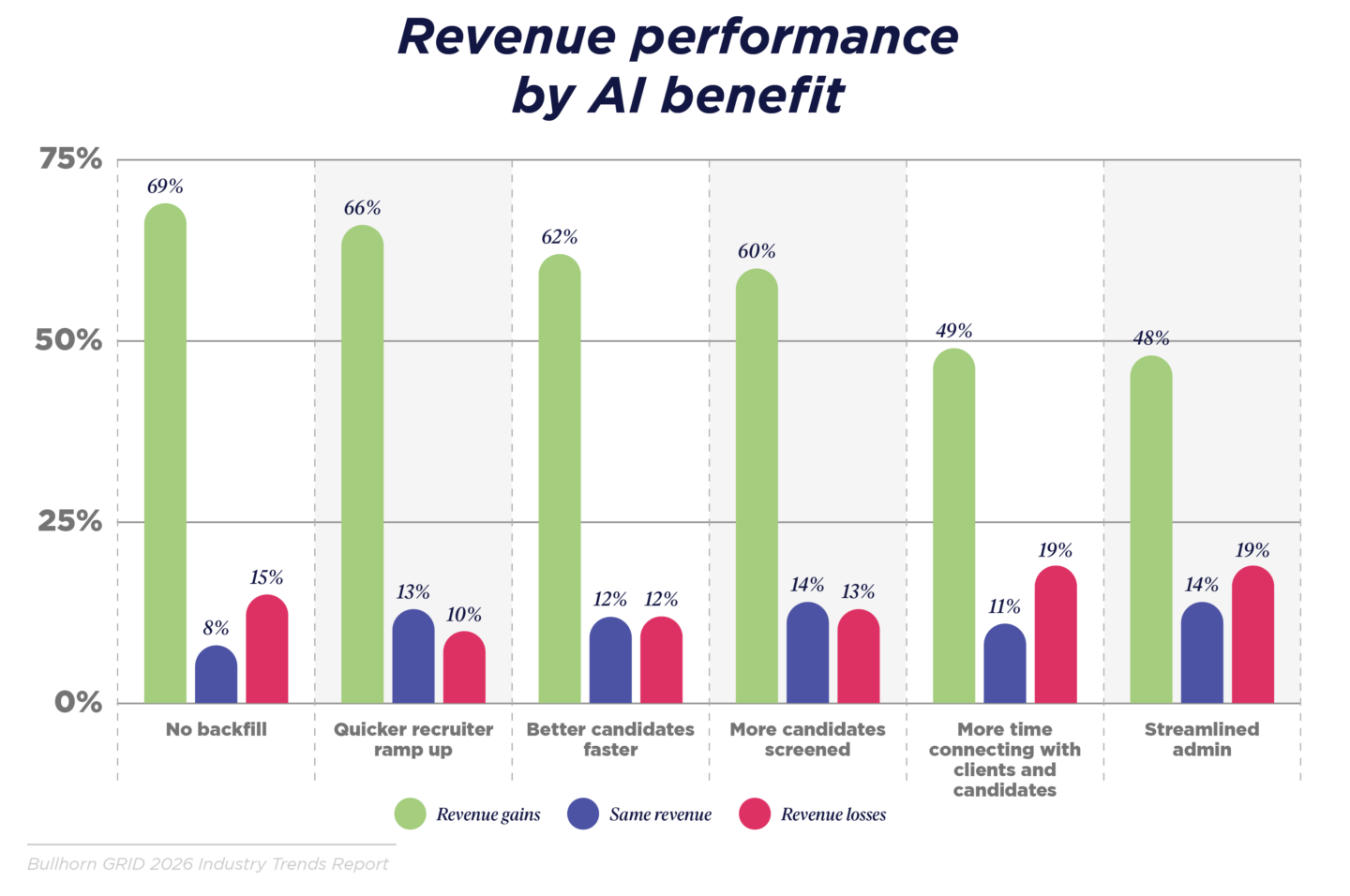
Fifty-one percent of leaders and 44 percent of recruiters say AI is already helping them identify better candidates faster, and this is the biggest benefit they are seeing from AI to date. The second biggest impact is more time to connect with clients and candidates. This came up time and again in Bullhorn’s conversations: that the true benefit of AI is in freeing up recruiters to do the relational work that truly differentiates firms. In fact, recruiters ranked this as the most important way that AI has improved their productivity.
Related: 6 Executive Search Trends Shaping Leadership in 2026
Recruiters report that searching for candidates takes up the most time in their day, followed by screening applicants. But AI is already having a huge impact on these time-consuming tasks. Most recruiters say AI is reducing the time they spend on searching for and screening candidates by 26-75 percent, freeing them up to work more jobs and do more relational work.
Still a Long Way to Go
In spite of the clear financial and operational benefits, Bullhorn found that many firms still have not fully embraced automation and AI across their platforms. Only 10 percent of firms report having AI embedded throughout their workflow. 2026 will likely be the year that sees AI in recruiting move from early adoption to full integration. Fifty-four percent of firms report that they have automation in place for search, and that percentage is even lower for middle office functions like payroll and billing. This landscape is likely to change drastically in the next year, especially since recruiters say overwhelmingly that search is the function they most want to automate, likely because it is where they spend most of their time.
Fewer than half of firms are using AI for any individual recruitment function. And only 10 percent of firms reported having agentic AI embedded throughout the workflow. That leaves a lot of room for growth and even greater revenue and KPI impact in the coming years.
Most leaders (71 percent) feel ready to lead their firms through AI transformation, but when Bullhorn dug deeper into the remaining obstacles that stand in the way of full adoption, there are some common themes. Data quality and security are challenges many firms have not quite been able to overcome. And 20 percent say they lack a clear implementation plan. These concerns are consistent for both leaders and recruiters alike. Leaders also report that they are working hard to help recruiters see and feel the benefits of AI in their work. One firm shared that they have created an intentionally diverse group of “AI ambassadors” to make sure the AI wins are relatable across all areas of the organization.
“Data and security concerns are top of mind for recruitment leaders with respect to AI,” the Bullhorn report said. “And these concerns stand in the way of full adoption of the technology. Firms need to work with partners that can help them address these foundational concerns to get the most out of AI.”
Leadership confidence tracks with performance. Eighty-one percent of leaders at the highest growth firms feel prepared to lead their organizations through AI transformation. Whereas only 46 percent of those with the weakest revenue performance felt prepared.
Economic Outlook
Forty-five percent of firms expect the economy to improve in 2026 (compared to 73 percent last year), so optimism has dampened, and almost as many expect it to stay the same (40 percent). Anecdotally, and from qualitative interviews, the expectation is largely for stabilization to modest improvement, not a radical snap back. However, everyone Bullhorn spoke with was optimistic about their own place in the recruitment ecosystem because they were focused on creating their own tailwinds regardless of prevailing market conditions. The bold leaders Bullhorn interviewed shared that they expect to gain market share, even if the total market shrinks, by being more agile and more efficient than competitors and using AI to enhance their “special sauce” rather than dilute it.
“Talent pools are still tight, and job volumes are still down, continuing the trend of the last few years,” the Bullhorn report concluded. “And two to three out of five candidates who receive offers are still turning them down. The top reason is that they received a better offer elsewhere.”
Related: From Experimentation to Infrastructure: How AI is Redefining Executive Search
Contributed by Scott A. Scanlon, Editor-in-Chief and Dale M. Zupsansky, Executive Editor – Hunt Scanlon Media