5 Ways to Evaluate a Job Offer in 2026

June 30, 2026 – In today’s hiring market, the strongest job offer isn’t always the one with the biggest paycheck. Candidates who treat their next move as a base-salary math problem usually leave real money behind, according to a recent report from Lyneer Search Group, an executive talent acquisition firm specializing in finance and executive roles.
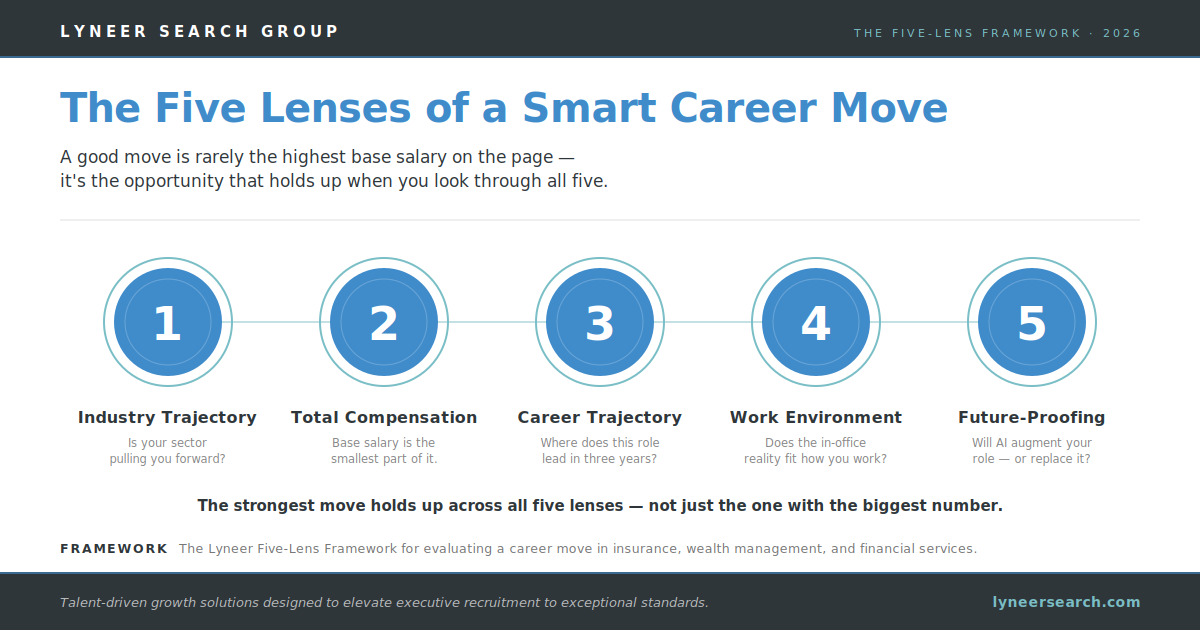
The smarter approach, and the one Lyneer has built its practice around, is to evaluate every opportunity through five lenses. The firm offers the framework, and how to apply it.
1. Industry Trajectory, is Your Sector Pulling You Forward?
This is the lens most candidates skip, and the one Lyneer leads every conversation with. The insurance industry is in the middle of a generational handoff: the Bureau of Labor Statistics and the National Association of Mutual Insurance Companies both project that roughly 400,000 insurance professionals will retire in the U.S. by the end of 2026, with about half the current workforce expected to retire within the decade.

Wealth management faces a parallel dynamic. McKinsey projects a shortfall of roughly 100,000 financial advisors by 2034 at current productivity levels, with advisor headcount having grown just 0.2 percent over the past decade.
“What this means at the candidate level: in our industries, experienced specialists (chief underwriting officers, controllers, fiduciary officers, senior planners, actuaries, COOs) are negotiating from a structurally stronger position than broad wage averages suggest. Industry-specific demand is the tailwind a national number can’t capture,” the Lyneer Search Group report said.
2. Total Compensation, the Base Number is the Smallest Part.
Bonuses, equity, deferred compensation, 401(k) match, profit-sharing, expanded healthcare, parental leave, and tuition reimbursement routinely add tens of thousands of dollars in annual value to a senior finance or insurance offer, sometimes more than the base salary differential between two competing positions, the Lyneer Search Group report explained.
Consider a senior financial analyst Lyneer recently advised through two offers at competing wealth platforms. The first carried a base salary $7,000 higher than the second. The second included a meaningful equity stake, a seven percent 401(k) match (versus three percent), and a defined two-year path to a director-level role. Modeled across a five-year horizon, the lower-base offer produced higher total compensation and a faster career arc.
“I tell every candidate I work with: bring me the full offer letter, not the base,” said Sandra Burreci, senior search consultant, Lyneer Search Group. “The number on the first line is rarely the number that matters most.”
3. Career Trajectory, Where Does this Role Lead in Three Years?
A corporate accountant we worked with last year accepted a controller role at a regional insurance carrier, at the same base they’d been earning. Their reasoning: the new firm had a defined succession plan mapping them into a VP Finance seat within 36 months. Eighteen months in, they’re on track. The salary trade-off they didn’t take has been more than recovered.
This is the calculus the firm’s results bear out. Ninety percent of Lyneer placements earn promotions within their organizations. That number comes from how carefully the firm evaluates fit during the search. A good move is measured by where it leads.
4. Work Environment, the Return-To-Office Picture has Hardened.
The Lyneer report explained that the return-to-office picture across financial services has clarified. Per BLS Q1 2026 telework data, finance and insurance remain the second-highest remote-adoption sector in the U.S. economy, behind only technology. But the trajectory is unmistakable: several major carriers, banks, and asset managers have moved to four or five days in-office for 2026, and the share of fully remote job postings continues to compress.
“For candidates, hybrid is the realistic floor for most senior finance and insurance roles now,” the report pointed out. “Remote-by-default is mostly gone. And the candidates who arrive at interviews with a clear, professional view on in-office presence are standing out to hiring managers. The return-to-office picture across financial services has clarified.”
Related: AI’s Growing Threat to Entry-Level Finance Hiring
Per BLS Q1 2026 telework data, finance and insurance remain the second-highest remote-adoption sector in the U.S. economy, behind only technology. But the trajectory is unmistakable: several major carriers, banks, and asset managers have moved to four or five days in-office for 2026, and the share of fully remote job postings continues to compress.
For candidates, hybrid is now the realistic floor for most senior finance and insurance roles — not “remote by default.” And the candidates who arrive at interviews with a clear, professional view on in-office presence are standing out to hiring managers.
“The candidates winning offers right now are the ones who walk in with a thoughtful answer to the hybrid question, not a hardened position either way,” said Mike Soscia, search consultant with Lyneer.
5. Future-Proofing, How AI is Changing the Work.
“The accounting and finance roles in our industries are changing fast,” the report continued. “The popular narrative gets the direction wrong.” The BLS projects five percent growth for accountants and auditors through 2034, with roughly 124,200 annual openings. Gartner has estimated that fewer than 10 percent of finance functions will see headcount reduction by 2026.

“What’s changing is the work itself,” the Lyneer report said. “Rules-based tasks like transaction categorization, basic reconciliation, and invoice processing are getting absorbed by automation. Judgment-based work is getting more valuable: forensic accounting, complex tax planning, CFO-level strategy, M&A diligence, fiduciary oversight. For candidates, the question to ask is: does this next role move me toward the work AI augments, or toward the work AI is replacing?”
For over 25 years, Lyneer Search Group has partnered with businesses to build, grow, and enhance their senior teams. The firm specializes in providing talent acquisition solutions for finance and executive roles, offering a personalized approach that focuses on long-term client relationships. By working closely with a select number of clients, Lyneer is able to deliver a high-touch experience, ensuring that the needs of each client’s entire finance organization are fully supported. Lyneer Search Group is headquartered in New York City.
Related: Why Your Most Difficult Hire Isn’t the One You Think
Contributed by Scott A. Scanlon, Editor-in-Chief; Dale M. Zupsansky, Executive Editor – Hunt Scanlon Media