AI’s Growing Threat to Entry-Level Finance Hiring

November 19, 2025 – AI is reshaping finance hiring and recruiters say that it’s hitting entry-level talent first. Artificial Intelligence isn’t coming—it’s already here, and it’s rewriting the rules of who gets hired in finance, according to a recent report from Lyneer Search Group, an executive talent acquisition firm specializing in finance and executive roles.
Microsoft’s Bill Gates predicts a world where humans “aren’t needed for most things” within a decade. “That sounds far-off—until you look at what’s already happening in financial hiring,” the Lyneer Search Group report said. A new Stanford study confirms it: AI is quietly reshaping the workforce. And the earliest casualties? Entry-level professionals in finance and accounting.

The study—Canaries in the Coal Mine? Six Facts about the Recent Employment Effects of Artificial Intelligence—analyzed payroll data from millions of U.S. workers. The conclusion is stark: firms using AI tools are slowing down hiring of younger employees, especially those aged 22–25.
“Meanwhile, senior professionals are not only holding steady but in many cases seeing job growth,” the Lyneer Search Group report said. “This isn’t a temporary blip. It’s a trend that started in late 2022, right as tools like ChatGPT began changing how teams work.”
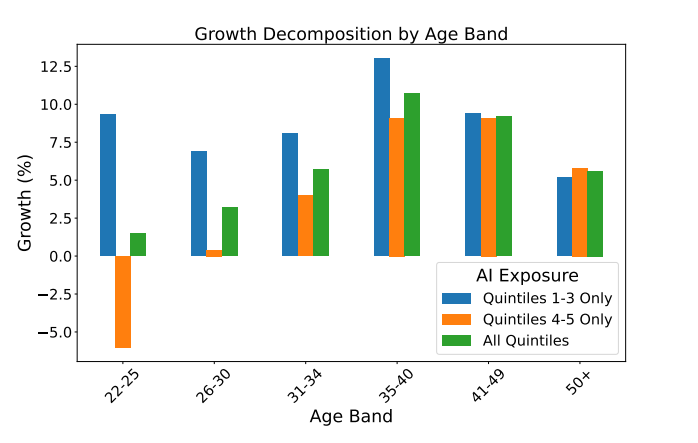
The graphic from the study explains that: For each age group, employment growth from late 2022 to July 2025 was six to 13 percent for the lowest three AI exposure quintiles, with no clear ordering in employment growth by age. In contrast, for the highest two exposure quintiles employment for 22-25 year olds declined by six percent between late 2022 and July 2025, while employment for workers aged 35-49 grew by over nine percent. These results show that declining employment in AI-exposed jobs is driving tepid overall employment growth for workers between the ages of 22 and 25.”
Why Entry-Level Roles are Being Replaced First
“AI thrives on textbook knowledge—the kind of skills you learn in school or early in your career,” the Lyneer Search Group report said. “Tasks like reconciliations, compliance checks, or variance analysis? AI can handle those, often faster and more accurately. But what AI can’t replace is experience: strategic thinking, business judgment, and deep client knowledge. And that’s where older employees maintain their edge.”
Lyneer Search Group’s Six Key Facts for Finance Hiring Managers
1. Young talent is at risk. Entry-level employees in AI-heavy roles are being hired less frequently than their experienced peers.
2. Overall jobs are growing—but not for juniors. Since 2022, hiring for 22–25-year-olds in finance roles dropped six percent, while hiring for older staff rose up to nine percent.
3. Automation cuts; augmentation protects. AI that automates routine tasks reduces junior hiring. But when AI supports complex work, headcount remains strong.
4. This trend isn’t about the economy. Even after adjusting for interest rates and cost-cutting, AI itself emerges as the clear cause.
5. Pay isn’t falling—just the number of hires. Salaries remain stable, but firms are opting to do more with fewer entry-level employees.
6. It’s a new shift, not a slow evolution. The hiring gap began around the same time as the generative AI boom. It’s not visible in older data.
What It Means for Hiring Teams in Finance & Insurance
The need to address this pipeline challenge is has arrived. If entry-level talent dries up, your future leadership bench weakens, according to the Lyneer Search Group report. “For firms in insurance, and wealth management, that’s a risk with long-term consequences,” it said. So what can hiring leaders do today to balance AI efficiency with sustainable workforce growth? Lyneer offers five key points”
1. Redefine early-career roles. Instead of staffing juniors exclusively on routine reconciliations, compliance checks, or variance analysis, recast entry-level positions as “learning labs.” Use them to build the skills that AI can’t replicate: strategic thinking, pattern recognition, and relationship-building.
Related: Post-Merger Integration Leadership: Hiring the Right Executives to Capture Deal Value
2. Prioritize human skills development. AI handles the technical grind. That means your junior staff should be trained where AI falls short—judgment, ethical reasoning, negotiation, and client trust. These are the qualities that move employees from “operators” to “future leaders.”
3. Treat AI as a talent multiplier. The firms that win in 2025 will treat AI as a co-pilot, not a replacement. Use AI to speed up data-heavy tasks so that early-career staff can focus on interpretation, storytelling, and advising. This dual focus makes work more engaging and accelerates employee development.
4. Accelerate knowledge transfer through mentorship. Institutional knowledge is your real competitive advantage. Pair juniors with seasoned mentors to fast-track tacit knowledge transfer. Structured mentoring ensures younger staff don’t just learn the “what,” but the “why” behind decisions—a skill AI cannot teach.
 The Select Guide to America’s Top 250 Executive Search Firms
Hunt Scanlon Media proudly presents the Select Guide to America’s Top 250 Executive Search Firms.
This comprehensive online directory is your definitive resource for finding the best executive search firms to serve your talent needs.
Our guide is meticulously curated to connect you with leading firms that specialize in various industries and functions, ensuring you find the perfect match for your executive recruitment needs.
5. Build career pathways with intention. If junior roles vanish, so does the leadership pipeline. Protect it by ensuring every early-career hire has a clear growth trajectory—from analyst to advisor, from controller to CFO. This not only secures your future leadership but also helps attract ambitious talent who want more than transactional work.
“AI can optimize your operations today, but without intentional hiring strategies, it risks hollowing out tomorrow’s leadership,” the Lyneer Search Group report said. “Forward-looking firms will design entry-level roles that grow human capital alongside technological capability.”
For over 25 years, Lyneer Search Group has partnered with businesses to build, grow, and enhance their senior teams. The firm specializes in providing talent acquisition solutions for finance and executive roles, offering a personalized approach that focuses on long-term client relationships. By working closely with a select number of clients, Lyneer is able to deliver a high-touch experience, ensuring that the needs of each client’s entire finance organization are fully supported. Lyneer Search Group is headquartered in New York City.
Related: Five Steps to Future-Proof Your Workforce
Contributed by Scott A. Scanlon, Editor-in-Chief and Dale M. Zupsansky, Executive Editor – Hunt Scanlon Media