Why Talent Strategy Is the Ultimate Lever for Private Equity Value Creation

July 10, 2025 – Private equity (PE) firms face more pressure than ever to create value. They’re holding companies longer and paying premium prices in an uncertain market with weak liquidity, according to a new report from DHR Global’s Keith Giarman. The study explained that intensifying trend means PE firms must work harder than ever to create tangible and sustainable value in their portfolio companies, deliver aggressive returns to meet investors’ expectations, and build and retain strong leadership teams across their portfolios. “It also creates and promotes high-performance cultures across their investments and proves to limited partners (LPs) that they can deliver returns in up and down markets,” the report said.
While talent matters throughout ownership, investors are now realizing how crucial it becomes at exit, according to the DHR report. Buyers scrutinize leadership capability closely, knowing that strong teams drive better returns. DHR explained that a strong talent strategy affects sale prices through:
- Well-defined succession plans for key roles.
- Leadership assessment at all levels.
- Development paths for high-potential leaders.
- Thoughtful and strategic organizational design.
- Well-articulated culture evolution plans tied to overall growth plan for the entity.
“Unlike in corporate environments where human resources and other initiatives can be somewhat mandated from the top, PE firms must cultivate the right strategic and tactical thinking in their portfolio companies, so talent planning is more assertively adopted and linked to value creation throughout the investment cycle,” the DHR report said.

Creating value through talent requires more than good intentions – it takes a system, the DHR report explained. “That’s where a Talent Operating Flywheel comes in,” it said. “A Talent Operating Flywheel is a strategic framework that connects talent decisions directly to a value creation plan and creates momentum at all levels in the organization to enable excellence and accelerated execution. It provides a clear road map for assessing, developing, and aligning leadership to drive financial performance for each portfolio company at every stage of the investment lifecycle. With it, PE firms can systematically fill critical roles, create high-impact succession plans, identify and elevate high-potential leaders at all levels who can drive business performance, and enable high-powered teams that exceed value creation expectations.”
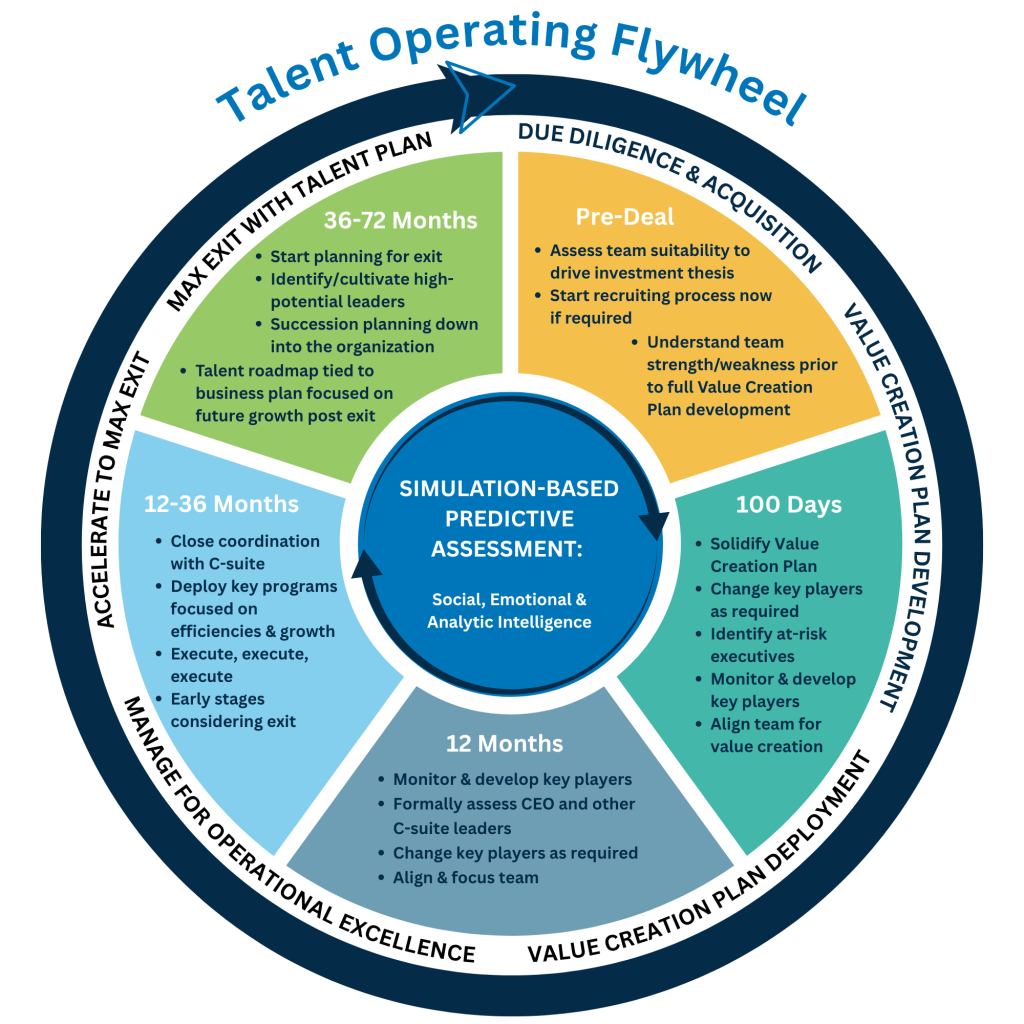
Rather than a one-off effort, the Flywheel is a continuous process that spans the entire hold period, optimizing the purchase price at exit, according to the DHR report. The firm explained that it helps uncover the talent-related drivers of value creation by addressing:
- Current leadership capabilities.
- Performance improvement needs.
- Cash flow acceleration requirements.
- Transformation priorities.
- Growth strategy alignment.
“These insights shape high-stakes decisions about what kind of leaders the company needs, where to find them, how to develop current talent, and what organizational changes will unlock the most value,” DHR said. “Just as important, the system ensures that culture and organizational design evolve in step with the company’s strategic direction. That alignment – between talent and value creation – is what turns human capital into a lever for transformation and, ultimately, higher valuations at exit.”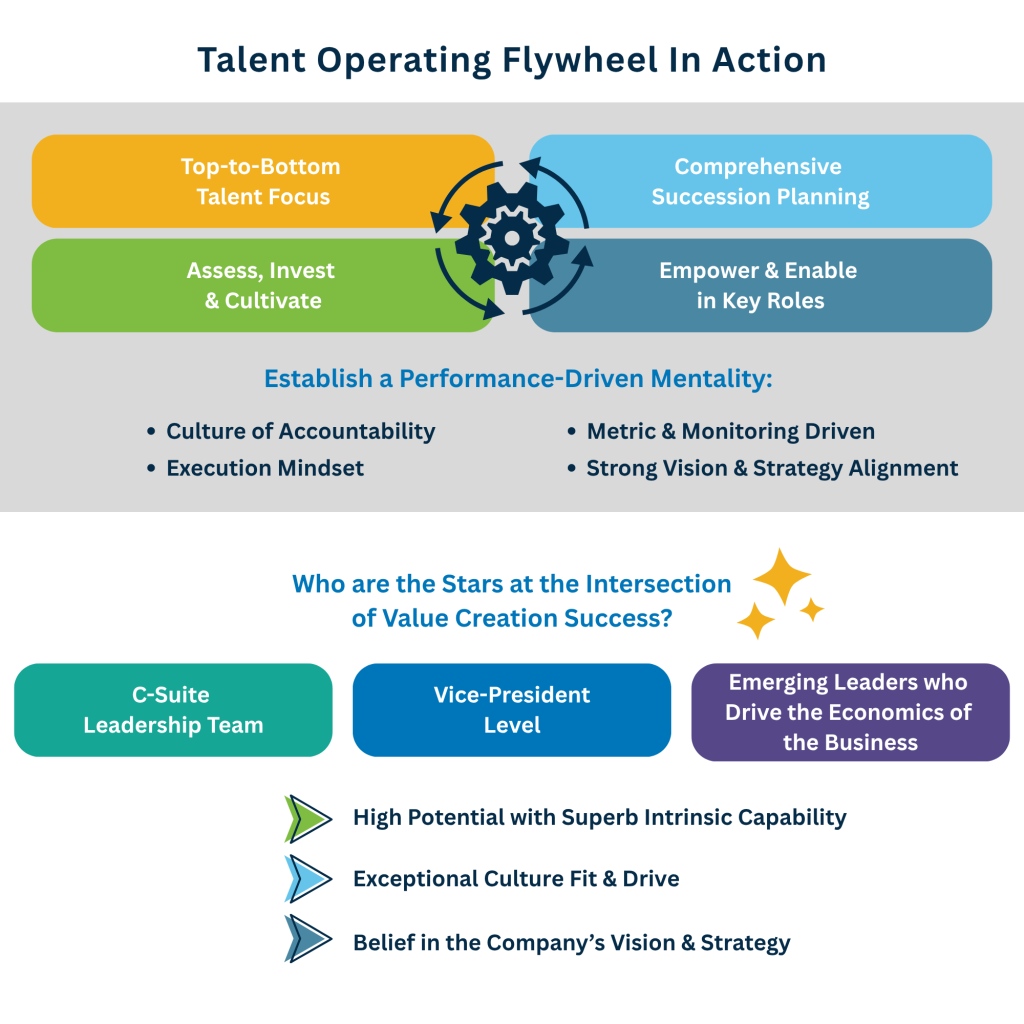
Meet the Talent Operating Flywheel Drivers
To implement this system, DHR explained that PE firms must have a senior leader, such as a chief talent officer, talent partner, or operating partner, who proactively leads talent management. This goes far beyond traditional recruiting, making sure high-impact people are in the “right seats on the bus.” The report noted that these leaders help portfolio companies:
- Find and develop the right leaders.
- Build strong teams.
- Create accountability cultures.
- Design talent strategies.
- Predict executive success.
Internal portfolio support leaders must assess each portfolio company’s unique situation to match leadership capabilities with business needs, according to the DHR report. “A turnaround requires different skills than a growth strategy,” it said. “They cultivate and/or select the right CEOs for each situation, then work alongside these leaders and their human resources teams to design talent strategies that prevent costly mistakes and drive value creation. Success demands a balance of strategic thinking and tactical execution.”
 The Select Guide to America’s Top 250 Executive Search Firms
Hunt Scanlon Media proudly presents the Select Guide to America’s Top 250 Executive Search Firms.
This comprehensive online directory is your definitive resource for finding the best executive search firms to serve your talent needs.
Our guide is meticulously curated to connect you with leading firms that specialize in various industries and functions, ensuring you find the perfect match for your executive recruitment needs.
Different business challenges require different types of CEOs. The DHR report explained that the senior leader overseeing talent must work with their internal PE peers to map strategic imperatives and business outcomes to the competencies, skills, and direct experience of potential CEOs in five key categories:
- Commercial Growth – Is the company’s path to value creation mostly dependent on the sale of existing services or products (organic strategy) in order to stimulate more rapid expansion?
- Market Innovation – Does the company face uncertain competitive pressures where a strategic reset, innovation, and new avenues for profitable growth will be required?
- Purposeful Transformation – Is value unlocked with strategic reengineering efforts that create efficiencies and increased profitability that sets the stage for accelerated revenue growth?
- Rapid Turnaround – Are radical changes required in cost structure to enable sufficient cash flow to stabilize the business and set the stage for a more methodical growth strategy (or sale)?
- Sustainable Scale – Is the company dependent on the build-out and optimization of an operational fabric that will allow for rapid, sustainable, and profitable scale?
“Understanding these strategic imperatives and business outcomes aligns the firm’s investment objectives with portfolio company needs to meet operational and financial targets,” DHR said.
Predicting Leadership Success
Effective talent systems depend on accurately predicting executive performance. One mistake can mean the difference between a successful and unsuccessful exit in terms of the overall internal rate of return (IRR) for the investment during the hold period, according to the study. Modern assessment tools like DHR’s Leader Lens measure three core types of executive intelligence crucial to ensure agility and effectiveness in their roles:
- Analytic (accomplishing tasks using skilled judgment).
- Social (recognizing different perspectives in interpersonal situations).
- Emotional (using constructive criticism to improve personal thoughts and actions).
“These tools use structured dialogues about real business scenarios to reveal how candidates think and make decisions, normed against a peer group of other executives in C-level roles,” the DHR report said. This approach helps PE firms:
- Prevent costly hiring mistakes.
- Spot future leaders early.
- Build strong succession plans.
- Match leadership skills to business needs.
- More effectively empower the team and overall company.
In today’s competitive environment, PE firms can’t afford to treat talent as an afterthought or settle for a more reactive way of thinking, the DHR report concluded. “They need a Talent Operating Flywheel that is continuously grinding to connect leadership decisions to value creation at every stage of the investment lifecycle,” the firm said. “The firms that win are the ones that treat talent with the same rigor they apply to capital allocation or market strategy. They deploy portfolio support leaders who know how to spot leadership potential, align people to business goals, and drive results through culture and structure. With the right leaders in the right roles, value creation accelerates – and valuations at exit rise. Talent isn’t just part of the strategy. It is the strategy.”
Related: Chief Human Resource Officers in Private Equity Funded Companies
Contributed by Scott A. Scanlon, Editor-in-Chief and Dale M. Zupsansky, Executive Editor – Hunt Scanlon Media