PRESS RELEASES
Uncovering the Career Motivations of Today’s Business Leaders [Original Research]
(January 2023) Why Are 72% of Professionals Considering a Job Change in 2023?
During these last few years of turbulence, trends like the Great Resignation and “quiet quitting” have dominated the headlines, while an undercurrent of economic unease and skyrocketing inflation have given rise to significant career anxiety. Against this landscape of uncertainty, many professionals are reportedly reassessing their career goals and plans for the future.
 Curious to learn more about this shift in goals and values, Slayton Search Partners recently conducted our second annual workplace survey, gathering original data about the motivations and experiences of today’s business leaders and professionals.
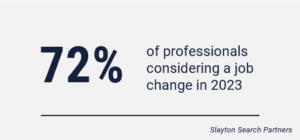
The results appeared to align with the overarching workplace trends of the last year. Of the professionals Slayton surveyed—most of whom were senior-level leaders and managers—72% reported they were seriously considering a job change in 2023.
If that number sounds shocking at first glance, let us provide some context. It is critical to note that not everyone who is seeking a new opportunity will actually find what they’re looking for or follow through on that desire. The actual quit rate—on a national, cross-industry basis—is right around 2.7%, according to the BLS.
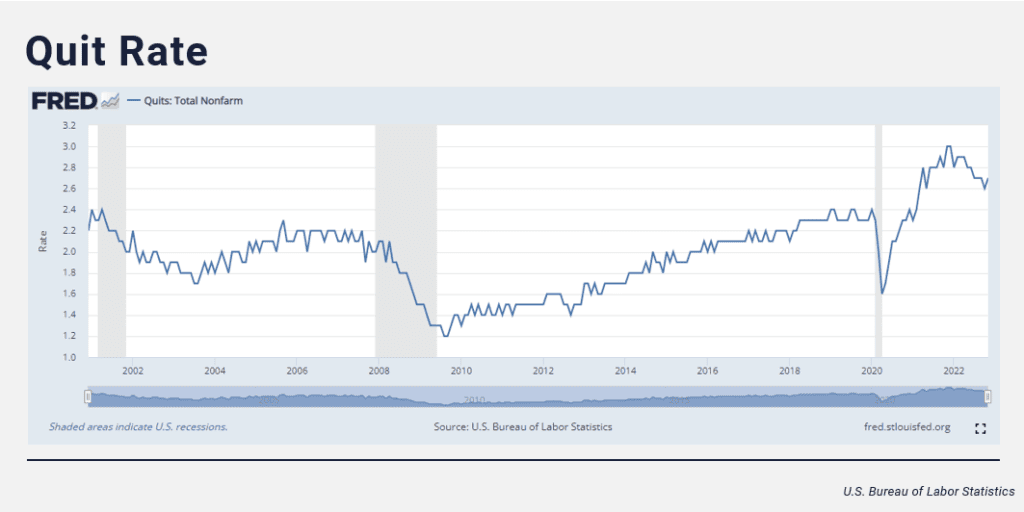
That said, as one can see in the graph above, that quit rate is at historic highs in recent months. There will always be a portion of the workforce who are reportedly looking for a new job, but with elevated quit rates and echoes of the Great Recession still rippling through headlines, it is important that business leaders understand the motivations of today’s professionals.
Why Are Professionals Seeking New Jobs?
Our data doesn’t appear to be an anomaly. Research from Deloitte agrees, revealing that almost 70% of C-suite leaders are serious about looking for a new job. Previous data from Qualtrics was also indicative of this trend, reporting that 53% of directors and managers and 51% of executives planned on searching for a new role back in 2022.
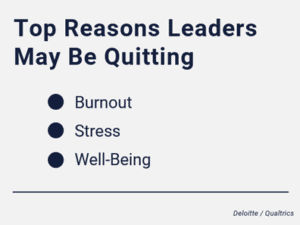
But why? Both Deloitte and Qualtrics suggest that burnout, stress, and well-being are the top reasons why leaders are quitting their roles. Behind the stress is the reality that workplace expectations have also shifted over the last few years.
Mental health, diversity, belonging, social justice, sustainability, and other factors behind the employee experience are all responsibilities that now fall on a leader’s plate. These are critical and well-intentioned responsibilities, but no one can deny they are also mentally and emotionally exhausting. Plus, these leaders are still responsible for leading their organizations to achieve maximized work performance, employee engagement, and overall profit. For organizations that aren’t conscious of their leaders’ well-being, losing those leaders is a serious possibility.
Burnout is why they’re leaving, but it’s equally important to understand what these professionals are looking for in their next role. Of those who changed jobs in 2022 and who are looking for jobs in 2023, the top three factors they were looking for were:
- Better career/professional growth potential (58.5%)
- Better values alignment (53.3%)
- Higher compensation/better benefits (43.7%)
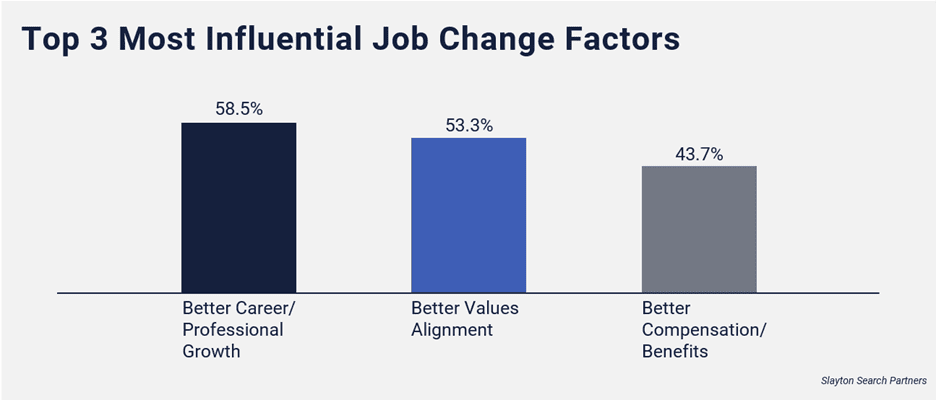
In both cases, the least influential factors were relocation, a career/industry change, and economic concerns.
What Motivates Professionals to Stay with an Existing Employer?
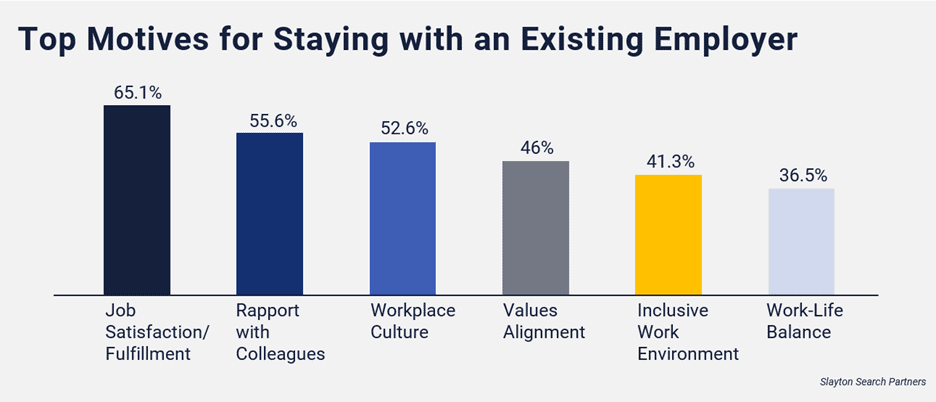
Though many of our survey respondents had changed jobs or were considering a job change, 17% said they hadn’t changed jobs, nor were they considering a job change. But why? And do their answers hint at a better retention strategy? The most heavily influential factors were as follows:
- Job fit satisfaction/fulfillment (65.1%)
- Rapport with colleagues (55.6%)
- Workplace culture (52.4%)
- Values alignment (46%)
- Inclusive Work Environment (41.3%)
- Work-life balance (36.5%)
McKinsey reports that the most important drivers of job satisfaction are interpersonal relationships and “having an interesting job.” They also identified five psychological needs that, when fulfilled by an organization, can help boost retention. These are: competence, autonomy, relationships, meaning, and purpose.
Ultimately, these factors add up to psychological well-being—and greater well-being leads to greater retention. McKinsey’s research showed that a professional with a high level of well-being at work is more likely to turn down a higher-paying job elsewhere. Which leads us to a discussion about compensation.
How Does Compensation Play a Role?
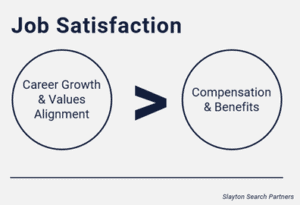 As mentioned above, for 43% of professionals who made a job change in 2022, compensation and benefits played an influential role. For those looking to make a change in 2023, 39% are considering compensation and benefits in their decision. However, this factor is always overshadowed by career growth and values alignment. In other words, compensation is important, but money isn’t everything.
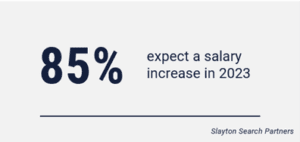
Interestingly, about 85% of survey respondents said they anticipated a salary increase in the next year. In the event these professionals don’t receive the expected raise, there was an even split between those who would accept the situation and let it go, those who would negotiate their salary with their existing employer, and those who would start looking for a new job.
However, a Gartner report points out that unless a professional is underpaid, compensation is unlikely to lead someone to quit. In fact, they say that the “era of the employment contract” is over—in other words, the transactional relationship between employee and employer is no longer a driving factor. Other components, as we’ve discussed above, have become more important than money.
Facing Economic Uncertainty
Compensation may not be the number one motivator, but what happens to employee expectations when faced with national economic uncertainty?
News and media outlets continue to push headlines about an impending global recession. However, sources are conflicting, and many say that any recession will be mild, and, though unemployment will increase, jobs growth—while slower—will still be positive.
That said, with news of a recession getting progressively louder, it is natural for workers to be concerned about the future of their jobs. This is the case even for the more senior-level executives whom we surveyed. One in three individuals reported some level of concern about job security in the current employment landscape.
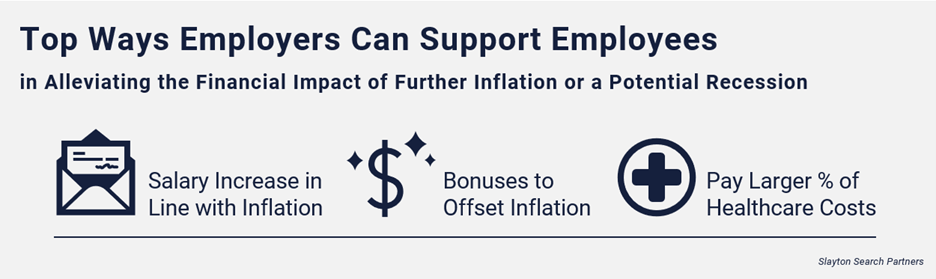
When asked how employers can best support employees in alleviating the impact of further inflation or a potential recession, the top-ranking factors were as follows:
- Provide salary increase in line with inflation
- Provide bonus to offset inflation
- Pay larger percentage of healthcare costs
Some organizations agree. Gartner research shows 63% of surveyed employers plan to adjust wages in response to inflation.
Of course, these employee expectations may not be realistic against a landscape of narrowing profits and inOf course, these employee expectations may not be realistic against a landscape of narrowing profits and increasing costs. In these cases, other strategies to relieve financial pressures may be enough to quell fears—think remote work, better communication of benefits, and investment in other valuable perks.
Furthermore, as we’ve previously established, a McKinsey survey that “relational” factors (such as feelings of value, trust, and belonging) are often more valued than “transactional” factors (such as pay). A toxic workplace on top of inflation and recession worries is a quick route to turnover, at all levels of seniority. But investing time and energy into career development, well-being, and values alignment can help retain the best leaders and professionals regardless of the economic reality.
The Career Motivations of Today’s Business Leaders
72% of professionals we surveyed said they are considering looking for a new job this year. While the number of those who do land a new opportunity will be significantly lower than that (according to historical trends), the extent to which leaders and managers are unhappy in their current positions is concerning. Money and economic uncertainty are certainly factors, but ultimately it appears that professional development, job satisfaction, and overall well-being are critical components in the decision to stay at or leave an employer.
What has been your experience?